

Table of Contents
- How to Determine Skin Undertone Before Choosing Lipstick
- Lipstick Shades for Cool Undertones
- Best Lipstick Colors for Warm Skin
- Lipstick Shades for Neutral Undertones and Olive Skin
- How to Choose Lipstick for Your Skin Depth
- How to Test Lipstick Shades Before You Buy
- Formula, Finish, and Skin Texture: What Most Guides Skip
- Choosing Lipstick for Skin Tone: Putting It All Together
Last Updated: August 17, 2026
How to Determine Skin Undertone Before Choosing Lipstick
Knowing how to choose lipstick for your skin tone starts with identifying your undertone. Undertone mismatch, not shade depth, is a common reason why shades that look perfect in the tube might not suit a person's face.
Undertone is the subtle hue beneath your skin's surface that remains constant regardless of how tan or pale you get. It falls into three categories: cool, warm, or neutral.
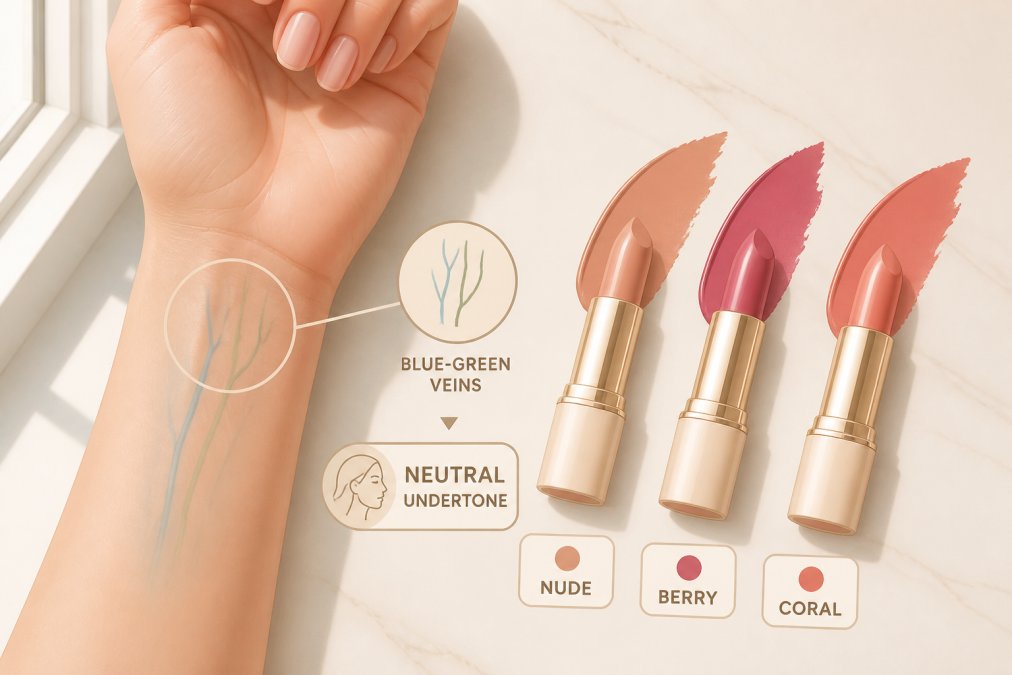
The Vein Test
Look at the inside of your wrist in natural daylight, away from artificial indoor lighting.
- Blue or purple veins indicate a cool undertone
- Green or olive-tinted veins indicate a warm undertone
- A mix of blue and green suggests a neutral undertone
The key word is natural daylight. Fluorescent office lighting skews veins toward green, throwing off the reading entirely.
The White Paper and Jewelry Tests
Hold a plain white sheet of paper next to your bare face. If your skin looks pink or rosy, you're likely cool-toned. If it looks yellow or golden, you're warm-toned. If you can't tell, neutral is your category.
The jewelry test works similarly. Cool-toned skin tends to look more alive next to silver; warm-toned skin glows against gold. Neutral undertones can wear both.
Run all three tests and see where two out of three point. That's your undertone.
Lipstick Shades for Cool Undertones
Cool-toned skin has pink, red, or bluish undertones, and the shades that work best share that same blue-based quality.
For cool undertones, reach for:
- Berry and plum shades, where blue-red pigmentation harmonizes with pink undertones
- Blue-based reds, a true red with a cool base looks sharp and intentional
- Mauve and dusty rose, muted pinks in the same color family as cool skin
- Wine and burgundy, deeper options that create contrast without clashing
Shades to avoid: orange-based reds, terracotta, warm peach, and bronze-toned nudes. These have yellow pigmentation that clashes with cool skin, making the complexion look washed out.
The most common mistake cool-toned women make is reaching for a peachy nude because it looks natural in the pan. On cool skin, peach reads muddy. A pink-leaning nude or cool mauve will always look more like "your lips but better."
Best Lipstick Colors for Warm Skin
Warm skin has yellow, golden, or peachy undertones, and the best lipstick colors mirror that warmth rather than fight it.
For warm undertones, the strongest choices are:
- Terracotta and burnt orange, earthy shades that echo the golden quality of warm skin
- Warm peach and coral, flattering across almost every warm complexion
- Brick red and tomato red, orange-based reds that complement rather than clash
- Caramel and toffee nudes, beige-leaning nudes with yellow or golden pigmentation
- Warm brown and copper, especially effective on medium to deep warm skin
What doesn't work on warm skin: blue-based reds, cool pinks, and anything with a distinctly purple or lavender base. These create an ashy, drained effect.
Warm-toned women often look spectacular in shades the beauty industry sometimes treats as "bold." Terracotta and brick tones that feel risky in theory tend to look effortless on warm complexions because the color harmony is built in.
Lipstick Shades for Neutral Undertones and Olive Skin
Neutral undertones have a roughly equal balance of warm and cool hues. Olive skin carries green or yellow-green pigmentation that can read as either warm or neutral depending on depth and lighting.
The best approach for neutral and olive skin:
- Rosy nudes, split the difference between pink and peach
- Soft berry, not too blue, not too warm
- Warm-neutral reds, look for shades described as "classic red" or "balanced red"
- Muted terracotta, works particularly well on olive skin
- Greige and brown nudes, taupe-adjacent shades that are almost universally flattering
Olive skin specifically benefits from avoiding anything too pale or too blue. Pale pink nudes can look ghostly; very cool purples can emphasize the green in the skin rather than complement it.
| Undertone | Best Lipstick Families | Shades to Avoid |
|---|---|---|
| Cool | Berry, mauve, blue-based red, wine | Peach, terracotta, orange-based red |
| Warm | Coral, brick, caramel, terracotta | Cool pink, lavender, blue-based red |
| Neutral | Rosy nude, soft berry, balanced red | Extreme cool or warm ends of the spectrum |
| Olive | Muted terracotta, warm berry, greige | Pale pink, icy lavender |
How to Choose Lipstick for Your Skin Depth
Undertone is the first filter. Skin depth, how light or deep your natural complexion is, is the second. The same shade can look completely different on fair versus deep skin because of contrast and color saturation.
Fair Skin
Fair skin has less melanin, so lipstick pigmentation shows up with high contrast. A bold berry pops dramatically, but a nude that's too close to your natural lip color can disappear entirely.
For fair skin: nudes should have enough pigmentation to register, look for pink-tinted or mauve nudes rather than skin-tone-matching beige. Bold shades like cherry red or deep berry create striking contrast. Avoid very dark shades like near-black plum without strong eye makeup to balance.
Medium Skin
Medium skin depth offers the most flexibility in terms of color payoff and contrast range. Most shades work, so the undertone filter becomes your primary guide. A nude that's too light looks chalky; one that's too dark looks heavy. Aim for nudes one to two shades deeper than your natural lip color.
Deep Skin
Deep skin has rich melanin that affects how lipstick pigmentation reads. Sheer or low-pigment formulas often don't show up at all. Deep skin benefits from high color payoff formulas, full-coverage matte or satin finishes, bold saturated shades like deep berry, plum, brick red, and warm brown, and bright shades like fuchsia or coral that pop beautifully against deep complexions. Avoid pale, chalky nudes that sit on top of the skin rather than blending into it.
How to Test Lipstick Shades Before You Buy
The biggest risk in buying lipstick online or in-store is choosing a shade that looks right in isolation but wrong on your face.
Swatching on your wrist is not enough. Your wrist has different undertones, texture, and pigmentation than your lips.
The right way to test lipstick shades:
- Apply directly to your lips, even a small amount on the center of your lower lip tells you more than a full wrist swatch
- Step into natural light, store lighting is almost always warm and flattering in ways that distort color
- Wait 60 seconds, your body heat and lip chemistry affect how the shade settles
- Look at your whole face, hold a mirror at arm's length and assess the shade in context
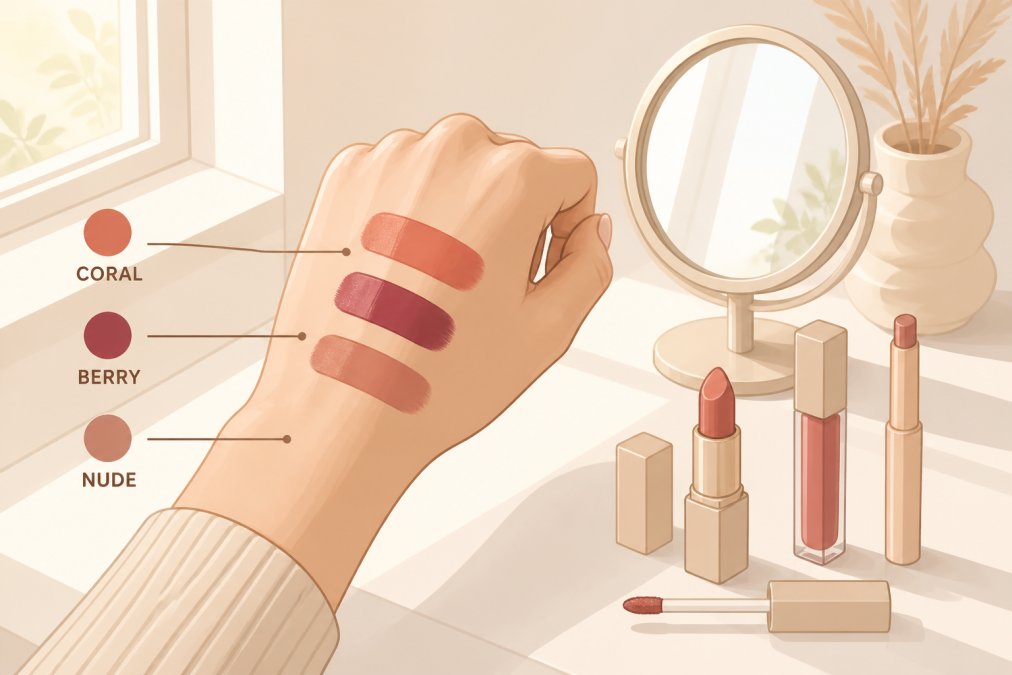
For online purchases, look for brands that offer virtual try-on tools or detailed undertone guidance in shade descriptions. Charmstyle Beauty Cosmetics provides shade guidance in product descriptions, noting which shades suit cool, warm, or neutral undertones.
Formula, Finish, and Skin Texture: What Most Guides Skip
Most guides stop at undertone and depth. Formula and finish interact with lip texture in ways that change how a color reads entirely.
Matte vs. Satin vs. Gloss for Different Lip Textures
Matte finish delivers the highest color saturation but emphasizes dry patches, fine lines, and uneven texture. For mature or dry lips, matte formulas require thorough exfoliation and a hydrating primer underneath.
Satin finish offers good color payoff with a slight sheen that reflects light and minimizes the appearance of texture. For most lip types, satin is the most forgiving everyday option.
Gloss reflects the most light, creating an optical plumping effect and making lips look fuller. For thin or mature lips, gloss is genuinely useful. The drawback is longevity, gloss moves and transfers frequently.
The practical rule: if you have smooth, well-hydrated lips, any finish works. If you have texture, fine lines, or dryness, satin or gloss will be more flattering than matte.
Lighting and Color Perception
Lighting changes how lipstick color reads on your face, sometimes dramatically.
- Natural daylight shows the truest version of any shade
- Warm indoor lighting makes cool shades look more neutral and warm shades look richer
- Cool fluorescent lighting makes warm shades look flat or muddy
- LED ring light tends to wash out pale shades and intensify dark ones
If you spend most of your day in an office with fluorescent lighting, test your lipstick under those conditions, not just in natural light.
Choosing Lipstick for Skin Tone: Putting It All Together
The framework for how to choose lipstick for your skin tone comes down to three sequential filters.
First: identify your undertone using the vein, white paper, and jewelry tests. This narrows your color family immediately.
Second: factor in your skin depth to calibrate contrast and color payoff.
Third: choose your finish based on lip texture and your daily lighting environment. A technically perfect shade in the wrong formula or tested under the wrong light can still disappoint.
A practical checklist before purchasing any lipstick:
- I've identified my undertone using at least two tests
- The shade I'm considering is in the correct color family for my undertone
- I've accounted for my skin depth (fair, medium, or deep)
- I've chosen a finish that suits my lip texture
- I've checked how the shade looks in natural light, not just store lighting
- I've applied it to my actual lips, not just my wrist
Shade selection doesn't have to be guesswork. With the right filters in place, finding a lipstick that genuinely flatters your complexion becomes a straightforward process. Charmstyle Beauty Cosmetics offers a curated collection of lightweight glosses, lipsticks, and stains designed to complement your natural complexion, with shade guidance built into every product. Get started with Charmstyle Beauty Cosmetics and find the shade that genuinely works for your skin tone.
Frequently Asked Questions
How do I figure out my skin's undertone for makeup?
The vein test is the most reliable starting point. Check the inside of your wrist in natural light. Blue or purple veins point to a cool undertone; green veins indicate a warm undertone; blue-green veins suggest neutral. You can also hold a white piece of paper next to your bare face: if your complexion looks pink or rosy, you're cool-toned; if it looks yellow or golden, you're warm-toned. Most people fall clearly into one category once they try both tests.
How do I choose the right lipstick color for my skin tone?
Start with your undertone, then factor in your skin depth. Cool undertones suit blue-based reds, berry, mauve, and rosy nudes. Warm undertones look best with peach, terracotta, coral, and orange-based reds. Neutral undertones can wear both. From there, adjust for depth: fair skin benefits from lighter tints and soft pinks; medium skin handles a full range; deep skin shines in bold, high-pigment shades. Swatching on your inner wrist or lower lip before committing saves a lot of guesswork.
What lipstick colors are most flattering for mature skin?
Satin and gloss finishes reflect light and add a subtle plumping effect, making them more flattering than heavy matte formulas on mature lips. Sheer nudes, soft roses, and medium berries tend to look polished without settling into fine lines. Avoid very dark or very dry matte shades, which can emphasize lip texture. A lightweight, moisturizing formula with good color payoff gives the most comfortable, even wear throughout the day.
Can my natural lip color affect how a lipstick shade looks on me?
Yes, your natural lip pigmentation acts as a base layer. Deeper natural lip color can shift a lipstick's hue darker or mute lighter shades like peach or nude. If your lips have strong natural pigmentation, try a slightly brighter or more saturated shade than you think you need, or apply a thin layer of concealer on your lips first to neutralize the base before applying color. Swatching on your actual lips, not just your hand, gives a far more accurate preview.
This article was written using GrandRanker