

Last Updated: October 25, 2026
Quick Summary
Finding your perfect red lipstick starts with understanding your skin by identifying your skin depth and recognizing your undertone. Match blue-based reds to cool undertones and orange-based reds to warm undertones, then test shades in natural daylight before committing.
- Skin depth ranges from fair to deep, separate from undertone, lighter reds work on fair skin, deeper reds on medium and deep skin.
- Use the vein test to find your undertone: blue-green veins suggest cool, green suggests warm, and an even mix suggests neutral.
- Test red lipstick under three lighting conditions in-store: natural daylight, warm indoor light, and cool or fluorescent light.
- Matte and liquid matte formulas last 4-8 hours, while cream formulas last 2-4 hours and require more frequent touch-ups.
- Apply red lipstick with a lip brush in thin layers, use a matching lip liner to prevent feathering, and blot between layers for a polished finish.
Table of Contents
- Understanding Your Skin Tone and How to Find Your Perfect Red Lipstick
- How to Choose Red Lipstick for Your Skin Tone
- Red Lipstick Undertones: Blue-Based vs. Orange-Based
- Blue-Based vs. Orange-Based Red Lipstick: Which Suits You
- Testing Red Lipstick Shades In-Store and Online
- How to Apply Red Lipstick Neatly for All-Day Wear
- Selecting Formula and Finish for Your Lifestyle
- Getting Started with Your Signature Red
- Frequently Asked Questions
Understanding Your Skin Tone and How to Find Your Perfect Red Lipstick
Finding your perfect red lipstick starts with understanding your skin. Finding your perfect red lipstick starts with understanding your skin by breaking this into two steps: identifying your skin depth and recognizing your undertone.
Get these right, and red becomes your signature shade.
Identifying your skin depth
Skin depth refers to how light or dark your complexion is, from fair to deep.
To find your skin depth, look at your face in natural daylight, fluorescent lighting distorts color.
Lighter reds work better on fair skin because they won't wash you out.
Recognizing your undertone
Your undertone is the subtle color beneath your skin's surface: warm, cool, or neutral.
To find your undertone, use the vein test: look at the veins on your inner wrist in natural light.
Another quick test: hold gold and silver jewelry near your face.
How to Choose Red Lipstick for Your Skin Tone
Once you know your depth and undertone, matching a red lipstick becomes straightforward.
Fair and light skin
Fair skin looks best with reds that have blue undertones or true reds without yellow, which prevent your complexion from appearing washed out. Learn more about choosing everyday lipstick for fair skin.
Fair skin with cool undertones: choose blue-based or classic true reds, bright reds with slight purple notes, for striking contrast.
Fair skin with warm undertones: opt for orange-based or warm true reds, which complement golden or peachy undertones without clashing.
Fair skin with neutral undertones: both blue-based and orange-based reds flatter you, experiment to see which feels more confident.
Medium and tan skin
Medium skin tones have more flexibility, both warm and cool reds work, depending on your undertone.
Medium skin with cool undertones: blue-based and cooler true reds create depth and sophistication and make your eyes pop.
Medium skin with neutral undertones: try both warm and cool reds, personal preference often matters as much as undertone.
Deep skin
Deep skin tones carry red lipstick beautifully.
Deep skin with warm undertones: warm reds, orange-based reds, and brick reds all work, feeling natural and enhancing your warmth.
Deep skin with cool undertones: blue-based and jewel-toned reds create stunning contrast and look intentional.
Deep skin with neutral undertones: you can wear nearly any red, your skin depth means the shade shows up clearly regardless of undertone.
Red Lipstick Undertones: Blue-Based vs. Orange-Based
The undertone of your red lipstick matters as much as your skin's undertone. Discover flattering lip shades for your undertone.
Blue-based red lipsticks contain blue or purple undertones and lean cool.
Orange-based red lipsticks contain warm, orange, or yellow undertones and lean warm. They feel natural and approachable, work best on warm undertones, and enhance golden or peachy complexions.
Blue-Based vs. Orange-Based Red Lipstick: Which Suits You
Here's the practical test: hold a red lipstick swatch next to your skin in natural light.
If you have cool undertones, blue-based reds feel natural. They blend with your skin's undertone and create a polished look.
If you have warm undertones, orange-based reds feel natural.
If you have neutral undertones, you can wear both.
| Skin Undertone | Best Red Type | Why It Works | Avoid |
|---|---|---|---|
| Cool | Blue-based red | Matches your undertone, creates polished contrast | Orange-based reds can appear harsh |
| Warm | Orange-based red | Complements golden/peachy tones, feels natural | Blue-based reds may feel disconnected |
| Neutral | Either works | You have flexibility to choose by preference | Neither will clash with your skin |
Testing Red Lipstick Shades In-Store and Online
Testing before you buy prevents costly mistakes. But most guides stop at 'try it in natural light.' A repeatable method is what separates a shade that looks good in the store from one you actually wear. Use this step-by-step approach for both in-store and online shopping.
CHARMSTYLEBEAUTY RED LIPSTICK →
The three-light test (in-store)
Red lipstick changes dramatically under different lighting. A shade that looks perfect under store fluorescents can turn orange or muddy in daylight. Always evaluate a swatch under three conditions before deciding:
- Natural daylight, Stand near a window or step outside. This is the most honest light. Look at the swatch on your lips, not just your hand.
- Indoor warm light, Move to an area with incandescent or warm LED bulbs (common in restaurants and evening venues). Does the red stay flattering or turn brassy?
- Cool or fluorescent light, Office and retail lighting often has a blue cast. Check whether the red turns purple or gray.
If the shade holds up in all three, it is a strong candidate. If it only works in one, keep looking.
The lip-swatch protocol
Swatching on your hand is a starting point, but your lips have different natural pigmentation and texture. Follow this sequence:
- Wipe lips clean with a tissue or makeup remover wipe. Residual balm or foundation changes how the red reads.
- Apply a thin layer to the center of your lower lip only. Do not fill in the whole lip yet.
- Press and blot with a tissue. This shows the true color rather than a glossy top layer.
Evaluating online shade descriptions
Online shopping removes the ability to swatch, so you need to decode how brands describe color. Most product pages use inconsistent language. Here is how to translate common terms:
- 'Blue-red' or 'cool red', Expect a shade with purple or berry undertones. These tend to flatter cool undertones and fair skin.
- 'Orange-red' or 'warm red', Expect tomato, brick, or coral leanings. These tend to flatter warm undertones and medium-to-deep skin.
- 'True red', A balanced red with neither strong blue nor orange. This is the safest starting point if you are unsure of your undertone.
Look for customer photos in reviews, especially from people who describe their skin tone and undertone similarly to yours. Brand swatch photos are often retouched and lit to make every shade look universal.
The sample-first rule
If a brand offers a sample, mini, or travel-size version, buy that first. A full-size red lipstick is a commitment; a sample lets you test the shade in your own lighting, with your own makeup, for a full day. Check the return policy before ordering full-size, many retailers accept returns on opened cosmetics within 30 days, but policies vary.
The photo check
Before you commit, take a photo of yourself wearing the shade in natural daylight. Look at the photo on a different screen (your phone, then your laptop) and in different lighting. Red lipstick can photograph differently than it appears in person, sometimes cooler, sometimes more saturated.
How to Apply Red Lipstick Neatly for All-Day Wear
The best shade means nothing if your lipstick feathers, fades, or looks patchy by noon. Application technique and preparation are everything.
Lip preparation and priming
Start with clean, exfoliated lips. Choose the right lip primer for your skin type to prepare your lips before applying red lipstick.
If your lips are dry, apply a thin layer of lip balm. Wait one minute, then blot away excess. This hydrates without creating a slick surface that causes feathering.
Application technique and preventing feathering
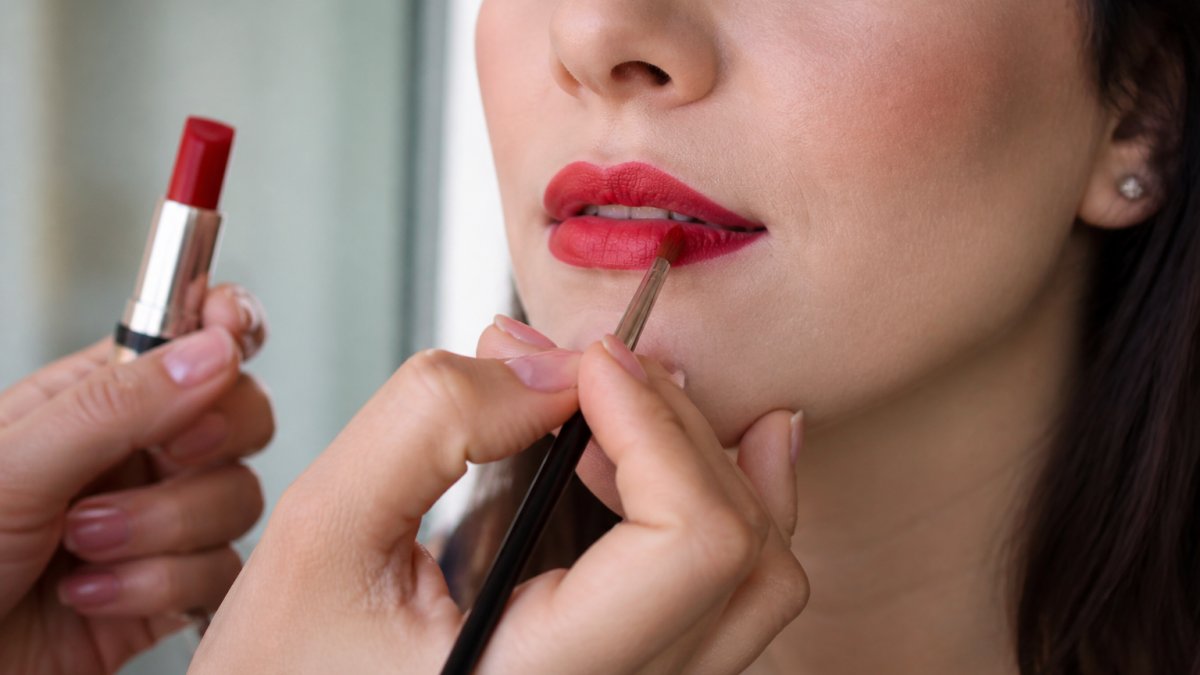
Use a lip brush instead of applying directly from the tube. Learn techniques to prevent lipstick from feathering during application.
Line your lips first with a lip liner that matches your red lipstick shade.
Apply your red lipstick in thin layers. One thick layer often looks patchy.
Blot with a tissue. This removes excess product and helps the color set. Apply a second layer.
Selecting Formula and Finish for Your Lifestyle
Red lipstick comes in different formulas and finishes, and the right one depends on your lips, your day, and how much maintenance you are willing to do. Most guides mention matte versus cream but skip the trade-offs that actually affect wear. Here is how to choose based on concrete factors.
Match the formula to your lip condition
Your natural lip texture and moisture level should drive the formula choice more than the color trend.
- Dry or flaky lips, Choose a cream, satin, or sheer formula. Matte and liquid lipsticks emphasize texture and can look patchy within an hour. A hydrating cream red with a slight sheen is more forgiving.
- Sensitive or easily irritated lips, Avoid long-wear liquid mattes that use drying alcohols or strong film-formers. Look for fragrance-free cream or satin formulas with emollients like shea butter or jojoba oil.
- Naturally pigmented lips, Sheer and satin formulas may not show true color. Choose a pigmented cream or matte that provides opaque coverage in one or two layers.
Wear-time expectations by finish
No formula lasts forever, but the finish gives you a realistic expectation for touch-ups.
- Matte and liquid matte, Typically 4-8 hours of wear depending on eating and drinking. These are the longest-wearing options but require lip prep (exfoliation and balm) to avoid drying. Reapplication can look cakey if you layer over faded product; remove and reapply for a clean finish.
- Satin, Typically 3-5 hours. Satin finishes offer a balance of comfort and wear. They fade more evenly than matte, so a quick touch-up blends in without removing the base layer.
- Cream, Typically 2-4 hours. Cream formulas are the most comfortable but transfer easily onto cups, masks, and napkins. They are best for short events or days when you can touch up.
Occasion and outfit context
The same red can feel right for a meeting and wrong for a wedding. Formula and finish signal different things.
- Professional settings, A satin or cream red in a true or blue-red shade reads polished without looking heavy. Matte can work but may feel intense for daytime office environments.
- Evening or events, Matte and liquid matte reds photograph well and hold up through dinner and photos. Deeper blue-reds and brick reds feel more formal than bright orange-reds.
- Casual or daytime, Sheer, tinted, or cream formulas in tomato or coral reds feel relaxed. Pair with minimal eye makeup so the lip is the focus.
Eye makeup and balance
A bold red lip is a statement. If you also wear heavy eye makeup, the face can look overdone. A common pattern is to keep eyes simple (mascara and a neutral shadow) when wearing a bright or matte red, and to balance a sheer red with slightly more eye definition.
Testing the formula before committing
Formula preferences are personal. Before buying a full-size red in a new formula, test it on your lips for at least two hours. Check for drying, feathering, settling into lines, and how it fades. A formula that feels comfortable at application can turn tight and dry by hour three.
Getting Started with Your Signature Red
You now have everything you need to find your perfect red lipstick.
Your perfect red lipstick is out there. It's the shade that makes you feel confident.
At Charmstyle Beauty Cosmetics, we believe red lipstick is more than color. It's a statement. It's confidence.
Frequently Asked Questions
How do I find the right red lipstick for my skin tone?
Start by identifying your skin depth (fair, light, medium, tan, or deep) and undertone (warm, cool, or neutral). Fair skin often flatters blue-based reds or true reds; medium and tan skin work well with orange-based reds or tomato shades; deep skin can wear almost any red, though blue-based reds tend to pop. Use the vein test: if your veins appear blue-purple, you're cool-toned; if blue-green or greenish, you're warm-toned. Test shades in natural daylight before committing.
Should I choose a blue-based or orange-based red lipstick?
Blue-based reds suit cool undertones and fair skin, creating a classic, crisp appearance. Orange-based reds complement warm undertones and deeper skin tones, adding warmth and vibrancy. Neutral undertones can wear both, so personal preference matters. Try both in-store under natural light to see which feels more confident on you. Testing is the best way to find your perfect match.
How can I tell if I have warm, cool, or neutral undertones?
Check your wrist veins in natural light: blue or purple veins indicate cool undertones, greenish veins suggest warm undertones, and a mix means neutral. Another test: hold gold and silver jewelry near your skin. If gold looks better, you're warm; if silver flatters more, you're cool; if both work equally, you're neutral. You can also observe which colors make you feel more confident, warm undertones often glow in peachy and golden shades, while cool undertones shine in jewel tones and silvers.
What should I do if I'm worried about getting the wrong shade online?
Start with a versatile, universally flattering shade like a true red or classic blue-red before experimenting with orange-based or tomato reds. Read reviews from customers with similar skin tones to yours.
Finding your perfect red lipstick takes a few minutes of preparation and testing. But once you do, you'll have a shade that works for you every single time. Red becomes effortless. Red becomes your signature.
Color theory and how undertones affect appearance
Skin tone identification and makeup selection guide
Cosmetic formulation and lipstick wear performance research
