

Table of Contents
- What 'Clean Beauty' Actually Means (And What It Doesn't)
- Is Clean Beauty Better for Sensitive Skin?
- How to Spot Greenwashing in Cosmetics
- Best Luxury Clean Lip Makeup Brands Worth Your Money
- The Hidden Chemistry of Product Spoilage and Shelf Life
- Budget-Friendly Clean Beauty: Does Lower Cost Mean Lower Quality?
- Frequently Asked Questions
Last Updated: September 15, 2026
What 'Clean Beauty' Actually Means (And What It Doesn't)
Is clean beauty actually worth it? The honest answer is that "clean beauty" is a marketing term, not a regulated category, so its value depends entirely on which brand you're buying from. At Charmstyle Beauty Cosmetics, we've watched this label get stretched to cover everything from genuinely thoughtful formulation to plain greenwashing. The term has no legal definition in the United States, which means any brand can print it on a label without meeting a single standard.
That ambiguity is the whole problem. When a word can mean anything, it ends up meaning nothing.
The Lack of Regulatory Standards Behind the Label
The U.S. Food and Drug Administration regulates cosmetics for safety and labeling, but it does not recognize "clean" or "natural" as defined claims (the FDA). According to the FDA's cosmetics labeling guidance, terms like "natural" have no official regulatory meaning. A brand can call a product clean while still using synthetic preservatives, or avoid the word entirely and still formulate responsibly. The label tells you about marketing, not chemistry.
Marketing Claims vs. Clinical Evidence
Clinical evidence is what a formulator can actually prove through testing: patch tests, stability tests, and dermatological safety reviews. Marketing claims are what sells. The gap between the two is where most "clean" positioning lives. A product marketed as clean may have no more testing behind it than a conventional one, and a conventional product may be far better studied. Worth is not determined by the word on the box.
Is Clean Beauty Better for Sensitive Skin?
Not automatically. Clean beauty products can be gentler for sensitive skin, but only when the specific formula avoids the ingredients that trigger irritation for that individual. "Clean" is not a synonym for "hypoallergenic," and botanical extracts, essential oils, and natural fragrances are among the most common causes of contact irritation (pubmed.ncbi.nlm.nih.gov).
If your lips or skin react easily, the useful step is patch testing any new product on a small area first, then waiting a day or two before full use. Read the ingredient list rather than the front label. A short, transparent list with clearly named preservatives usually beats a long list of plant extracts with no explanation of what keeps the formula stable.
How to Spot Greenwashing in Cosmetics
Greenwashing is when a brand uses vague environmental or "clean" language to imply a safety or ethics standard it does not actually meet. The giveaway is almost always the absence of specifics: no named certifications, no full ingredient disclosure, and claims like "chemical-free" that are scientifically impossible, since water itself is a chemical.
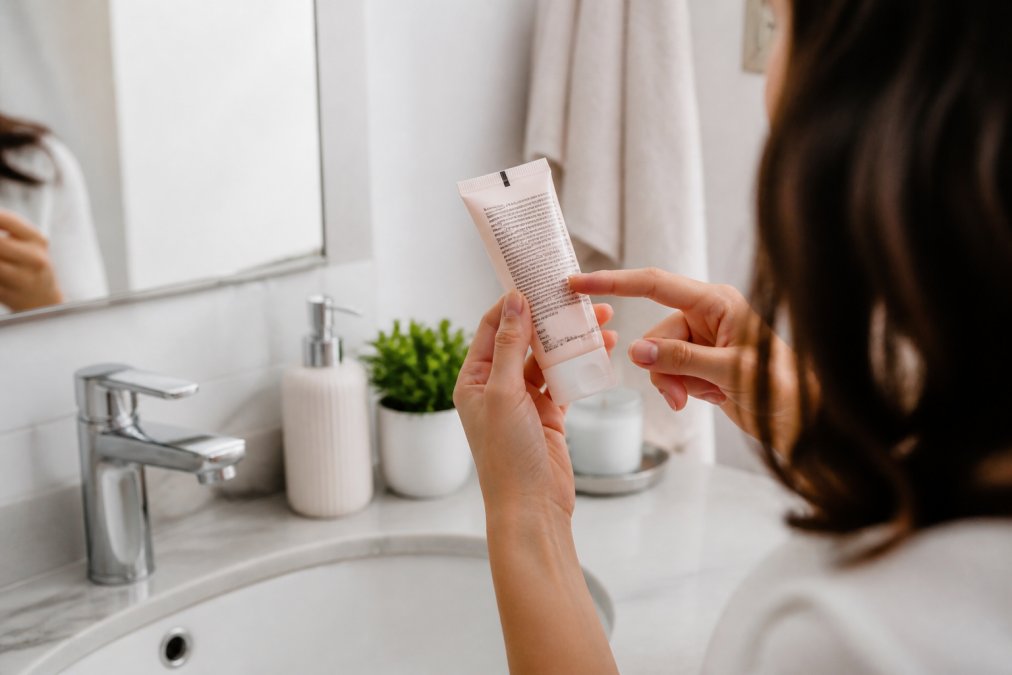
Look for brands that name their standards rather than gesture at them. Transparency means publishing full ingredient lists, explaining why each preservative is used, and being specific about what "vegan" or "cruelty-free" means for that company.
Reading the Ingredient List Like a Formulator
Start at the top, where ingredients are listed in order of concentration, and work down. Preservatives like parabens, phenoxyethanol, and formaldehyde-releasers appear in small amounts, but their presence is not automatically a red flag; a product with no preservative system at all is a bigger concern for microbial contamination and spoilage. Ask three questions: What keeps this formula stable? What is the preservative system? Does the brand explain its choices? A brand that answers those openly is usually the real thing.
Best Luxury Clean Lip Makeup Brands Worth Your Money
The best luxury clean lip makeup brands are the ones that pair transparent formulation with a color range that actually performs, not just a clean label. Charmstyle Beauty Cosmetics offers lightweight, wearable glosses, lipsticks, and stains designed to enhance your everyday confidence. For busy professionals who want a natural, polished look without a heavy feel, this combination is designed to be hard to beat.
When you compare options, weigh them on the same criteria:
| Brand | Formulation Focus | Best For | Transparency |
|---|---|---|---|
| Charmstyle Beauty Cosmetics | Lightweight lip glosses, lipsticks, stains | Everyday natural looks | Full ingredient disclosure |
| Brand B | Botanical-forward lip color | Fragrance lovers | Partial disclosure |
| Brand C | Minimalist lip tints | Very reactive skin | Named preservatives |
| Brand D | Pigment-heavy lipsticks | Bold color | Limited disclosure |
The pattern is consistent: the brands worth the premium are the ones that tell you what's inside and why. Price alone proves nothing.
The Hidden Chemistry of Product Spoilage and Shelf Life
Product spoilage is a microbial and chemical process, and understanding it is the single best way to judge whether a "clean" formula is actually well made. Without an effective preservative system, water-based formulas become breeding grounds for bacteria, yeast, and mold, and oils eventually oxidize and turn rancid. This is why "preservative-free" is not the flex marketing makes it out to be. A lip product needs a functioning preservative system to stay safe through its shelf life.
The mechanism comes down to water activity. Any formula that contains water, emulsions, creams, liquid lip products, gels, provides the moisture microbes need to multiply. Preservatives like phenoxyethanol, parabens, and formaldehyde-releasers work by interrupting that growth, and they appear in small concentrations because that is all a functioning system requires. Oil-based formulas are a different story: they do not support microbial growth the same way, but their oils oxidize when exposed to oxygen, light, and heat. That is why oil-based products rely on antioxidants like vitamin E rather than antimicrobial preservatives. A formula that skips both is not purer, it is simply unprotected.
Shelf life is set by stability testing, not by a vibe. Manufacturers run accelerated aging tests and microbial challenge tests to establish an unopened shelf life, then assign a period-after-opening (PAO) window, the small open-jar symbol with a number inside, usually 3M, 6M, or 12M. Once a product is opened, its usable window shrinks because air, fingers, and applicators introduce microbes. A lip gloss with a 6M PAO is telling you something concrete: replace it about six months after opening, not when it starts to smell off.
A practical storage guide for anyone buying clean-positioned products:
- Keep water-based formulas cool and closed. Heat accelerates both microbial growth and emulsion breakdown. A bathroom windowsill is the worst place for a cream or liquid lip product.
- Store oils away from light. UV exposure speeds oxidation. Amber or opaque packaging is not decoration; it is functional.
- Do not add water to stretch a product. Diluting a preserved formula lowers its preservative concentration and can push it below the level needed to stay safe.
- Use clean applicators and avoid double-dipping. Fingers and shared brushes are the fastest route to contamination.
- Trust the PAO, not the smell. Rancid oils and microbial growth do not always announce themselves.
If a clean brand skips preservatives to look purer, it may be trading safety for a label claim. That is a trade most consumers should refuse, and it is the clearest example of why "clean" and "well-formulated" are not the same thing.
Budget-Friendly Clean Beauty: Does Lower Cost Mean Lower Quality?
Lower cost does not automatically mean lower quality, but it does change what a brand can afford to do. Budget clean beauty often relies on fewer, well-understood ingredients and simpler packaging, which can be perfectly safe and effective. What you tend to lose at the low end is testing depth, color range, and the finish quality that luxury formulas spend money to achieve.
The smart approach is to spend where it matters for you. If you want long-wear color and a comfortable feel, pay for formulation.
Frequently Asked Questions
Is clean beauty just a marketing term for greenwashing?
Not always, but the lack of FDA regulation means 'clean' can mean anything. Some brands use it to genuinely avoid questionable ingredients like parabens and phthalates, while others slap the label on without changing their formulas. Look for third-party certifications like EWG Verified or Leaping Bunny, and check if the brand discloses full ingredient lists. If a brand can't explain what 'clean' means to them, treat it as marketing.
Is clean beauty better for sensitive skin?
It depends on the formula, not the label. Some people react to synthetic preservatives, while others react to botanical extracts or essential oils. Some studies suggest that 'clean' products can still cause irritation if they contain allergens. Patch testing is your best bet: apply a small amount to your inner arm and wait 24 hours. If you have sensitive skin, look for fragrance-free and hypoallergenic options, regardless of clean claims.
How do I spot greenwashing in cosmetics?
Watch for vague terms like 'chemical-free' (everything is a chemical), 'natural' (poison ivy is natural), and unverified claims like 'dermatologist-tested' without a named institution. Check if the brand lists preservatives like phenoxyethanol, which are safe but sometimes hidden behind 'clean' marketing. Cross-reference ingredients on the EWG Skin Deep database. If a brand spends more time on leafy graphics than on transparency, be skeptical.
Are luxury clean lip makeup brands worth the higher price?
Sometimes. Higher prices can reflect better ingredients, ethical sourcing, and smaller batch production, but they can also just cover fancy packaging. For lip products, check if the formula contains nourishing oils like jojoba or shea butter and avoids known irritants. If a brand checks those boxes and fits your budget, the extra cost may be justified.
The challenge with clean beauty is that the label hides more than it reveals, and the only way to judge worth is to look past the marketing. At Charmstyle Beauty Cosmetics, we built our lip collection on lightweight, wearable formulas with clear ingredient disclosure, so you can choose a gloss, lipstick, or stain that fits your everyday routine without guesswork. Explore the collection and find the shade that elevates your natural glow.