

Last Updated: November 4, 2026
Quick Summary
Sun protection lips means applying a broad-spectrum lip balm with at least SPF 30 every morning, because lips have thin skin and little melanin. Reapply outdoors at least every two hours and after eating, drinking or swimming. Choose a formula with broad-spectrum coverage and check the ingredients for fragrance or menthol if your lips are sensitive.
- Your lips have very thin skin and little natural melanin, making them highly sun-vulnerable.
- Look for SPF 30 or higher, broad-spectrum protection and water resistance on the label.
- Reapply lip SPF at least every two hours outdoors and after eating, drinking or swimming.
- Water-resistant lip products are tested to 40 or 80 minutes of water activity.
- Exfoliate two to three times a week and apply SPF balm every morning for a simple routine.
Table of Contents
- Why Your Lips Need Sun Protection
- How to Choose the Right Lip SPF: SPF 30, Broad-Spectrum, and Water-Resistant
- Physical vs. Chemical UV Filters in Lip Products
- Ingredients to Look For and Ingredients to Avoid
- Is SPF in Lipstick Enough? What Daily Makeup Actually Protects
- How Often to Reapply and Application Techniques for Long-Wear
- How to Treat Sunburned Lips and Prevent Dry, Chapped Lips
- Building Your Daily Lip Protection Routine With Charmstyle
- Frequently Asked Questions
Your lips have very thin skin and little natural melanin, which makes them one of the most sun-vulnerable parts of your face, so sun protection for lips should be part of your daily routine. Most people apply sunscreen to their face and forget the lips entirely. This guide explains why lip sun protection matters, how to choose a lip SPF, and how to build a daily routine that fits into a busy morning.
Why Your Lips Need Sun Protection
Sun protection for lips is the use of a UV-filtering product, usually a lip balm or tinted lip product, to shield the lips from ultraviolet radiation. Lips are exposed to UVA and UVB rays every day, and they are easy to overlook.
We recommend treating sun protection lips as a daily habit rather than a beach-day extra. The exposure adds up across commutes, errands and walks, even on overcast days.
Why the Vermilion Border Burns and Ages Faster
The vermilion border, the transition line where the lip meets the surrounding skin, is especially prone to damage. It is thin and has few protective pigments, so UV exposure there can lead to dryness, peeling and, over time, changes in texture. Many people notice the border looking less defined before they notice anything else.
How to Choose the Right Lip SPF: SPF 30, Broad-Spectrum, and Water-Resistant
Look for three things on the label: SPF 30 or higher, broad-spectrum protection (covering both UVA and UVB), and water resistance if you sweat or swim. Broad-spectrum coverage matters because UVA rays contribute to aging while UVB rays drive burning.
A tinted formula can make it easier to remember to reapply. The Charmstyle Beauty Lip Balm, priced at $10.00, is one option to consider for everyday use.
The three label checks that matter most for a lip SPF are summarised below.
| Label check | What to look for | Why it matters |
|---|---|---|
| SPF | 30 or higher | Sets the baseline level of UV protection |
| Spectrum | Broad-spectrum | Covers both UVA and UVB rays |
| Water resistance | Water-resistant, if you sweat or swim | Helps protection hold up during activity |
Physical vs. Chemical UV Filters in Lip Products
Physical filters such as zinc oxide and titanium dioxide sit on the surface of the skin and reflect UV light. Chemical filters absorb UV rays and convert them to heat. Physical filters are often preferred for sensitive or dry lips because they tend to irritate less, though formulas vary, so check the ingredient list against your own tolerance.
Ingredients to Look For and Ingredients to Avoid
A lip SPF is only as good as its full formula, not just its SPF number. Read the drug facts panel for the active UV filters, then read the inactive ingredients for what supports or undermines the lip barrier.
UV filters to look for. The FDA sunscreen monograph recognizes a short list of UV filters for over-the-counter use, and the ones most common in lip products are zinc oxide, titanium dioxide, avobenzone, octinoxate, octisalate, homosalate, and octocrylene. Zinc oxide and titanium dioxide are mineral filters that sit on the surface and scatter both UVA and UVB; they are the usual choice for people with sensitive or eczema-prone lips. Avobenzone is the workhorse UVA chemical filter in the U.S. market, but it degrades in sunlight unless it is stabilized by octocrylene or a similar partner, so a formula listing avobenzone alone is worth a second look.
Barrier and antioxidant support. Beyond the filters, look for occlusives and humectants that hold moisture in thin lip skin: petrolatum, dimethicone, shea butter, jojoba oil, and ceramides. Antioxidants such as vitamin E (tocopherol) and green tea extract do not replace UV filters, but they help blunt the free-radical cascade that follows UV exposure. Niacinamide appears in some newer lip formulas for barrier support, though evidence specific to the lips is limited.
Ingredients to treat with caution. Fragrance and flavoring are the most common causes of allergic contact cheilitis on the lips, and the usual culprits are balsam of Peru, cinnamal, and peppermint oil. Menthol, camphor, and phenol give a cooling tingle but can dry and irritate already-compromised lips. Propyl gallate and some older preservatives are also frequent sensitizers. If your lips sting, peel, or swell after a new balm, stop using it and patch-test on the inner arm first.
A note on SPF claims. The FDA regulates lip SPF as an over-the-counter drug, so the label must carry a drug facts panel with the active ingredients and their percentages. A balm marketed as "sun protection" without that panel is making a cosmetic claim, not a drug claim, and you should not rely on it for UV defense.
Watch out: a high-SPF balm loaded with fragrance and menthol can leave lips more irritated than unprotected, so match the formula to your lip tolerance, not just the number on the front.
Is SPF in Lipstick Enough? What Daily Makeup Actually Protects
Lipstick with SPF can contribute to protection, but most people do not apply enough product to reach the labeled SPF level, and color wears off through eating and drinking. If you wear color every day, see what happens to your lips when you wear long-lasting lipstick daily. Treat SPF lipstick as a supplement to a dedicated lip balm, not a full replacement, especially outdoors.
How Often to Reapply and Application Techniques for Long-Wear
The two-hour rule is the floor, not the ceiling. Reapply lip SPF at least every two hours outdoors, and sooner after eating, drinking, swimming, or heavy sweating. Water-resistant lip products are tested to 40 or 80 minutes of water activity under the FDA labeling rules, so "water-resistant" does not mean all-day.
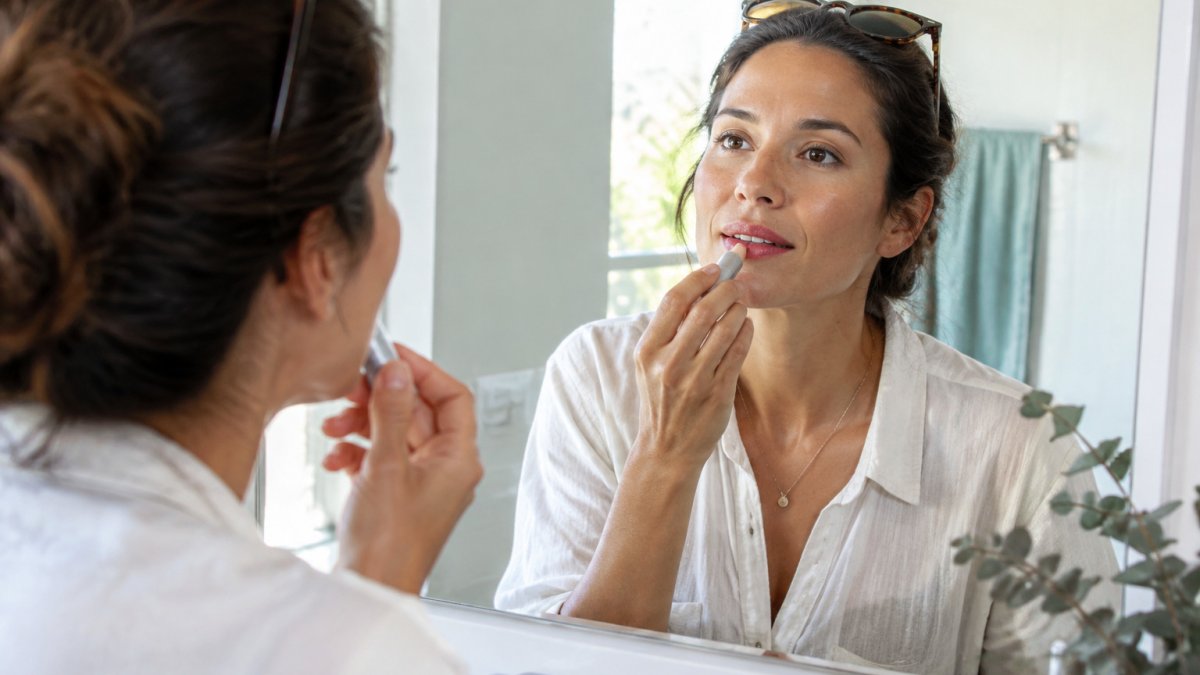
Apply enough to matter. SPF testing assumes about 2 milligrams of product per square centimeter of skin. Lips are small, but most people swipe once and move on, which delivers a fraction of the labeled SPF. A practical target is two passes over the lips, letting the first set for about a minute before the second.
Layer under lipstick without ruining the finish. This is where most guides stop at "reapply" and leave you with a smeared look. The workable sequence is: apply a thin layer of SPF balm, blot with a tissue to remove the shine, then apply lip liner and lipstick on top. A tinted SPF balm can serve as the base color itself, which is why a tinted formula is easier to maintain through the day. For a matte finish, choose a matte SPF balm rather than powdering over a glossy one, which tends to pill.
Reapply over makeup. Carry a stick or tinted balm rather than a squeeze tube; press it on with a fingertip or the stick itself instead of dragging, so you do not lift the color underneath. If you wear a long-wear liquid lipstick, accept that reapplication will disturb it and plan to touch up the center of the lip first.
Timing around meals. Reapply after coffee, not before. Hot drinks and food wipe product off the vermilion border faster than the two-hour clock suggests, and the border is the area most prone to actinic damage.
Watch out: layering a chemical-filter balm under a heavy occlusive lipstick can trap heat and irritate sensitive lips, so if you react, switch to a mineral-filter base.
How to Treat Sunburned Lips and Prevent Dry, Chapped Lips
Sunburned lips should be cooled with a cold compress, kept moisturized with a simple, fragrance-free balm, and protected from further sun while they heal.
To prevent dryness, combine daily SPF with gentle exfoliation and regular hydration. Watch out: applying a heavy scrub to already-sunburned lips can make the damage worse, so wait until they have calmed down.
Building Your Daily Lip Protection Routine With Charmstyle
A simple routine takes under a minute: exfoliate with the Charmstyle Beauty Strawberry Lip Scrub ($8.00) two to three times a week, apply a broad-spectrum SPF 30 balm every morning, and reapply outdoors. To round out your lip products, see how to build a professional lip makeup kit in seven steps. For a daily-use option, the Charmstyle Beauty Lip Balm fits this step.

Frequently Asked Questions
Why do lips need sun protection?
The skin on your lips is thinner than the skin on your face and has few melanin-producing cells, so it has less natural defense against ultraviolet radiation. The vermilion border, the outline of your lips, is especially exposed. Repeated UVA and UVB exposure can contribute to dryness, chapping, collagen breakdown, hyperpigmentation and, over many years, actinic cheilitis, a precancerous change. Daily lip protection with broad-spectrum SPF helps limit this cumulative damage, particularly if you spend time outdoors or in the car.
What SPF should I use on my lips?
Dermatology guidance generally recommends a broad-spectrum sunscreen of SPF 30 or higher for lips, the same standard used for the face. Look for the words broad-spectrum on the label, which indicates protection against both UVA and UVB rays. Water-resistant formulas are useful if you eat, drink or sweat outdoors. Charmstyle lip products are formulated for everyday wear, so check each product's label for its listed SPF before relying on it for extended sun exposure.
How often should I reapply lip balm with SPF?
Reapply lip SPF about every two hours when you are outdoors, and sooner after eating, drinking, swimming or sweating, since these remove product. Indoors near windows or during a commute, reapplying a few times a day is a reasonable habit. Dry, chapped lips can also drive more frequent reapplication, so keeping your lips hydrated helps the product stay where it belongs.
Does lip gloss provide sun protection?
Most lip glosses do not provide meaningful sun protection unless the label explicitly lists an SPF and broad-spectrum protection. Gloss is often applied in thin layers and tends to wear off quickly, which reduces the amount of protection you actually get. If you want a glossy finish with protection, look for a lip balm or gloss whose label confirms SPF 30 or higher, and reapply it the same way you would any sunscreen.
What are the signs of sun-damaged lips?
Common signs include persistent dryness, peeling, cracking, a rough or scaly texture, uneven pigmentation, and a lip border that looks blurred or thinned. Sunburn-related swelling and blistering are obvious warning signs. A white, rough or raised patch that does not heal over several weeks should be examined by a dermatologist, because actinic cheilitis can progress and needs professional evaluation.
Is SPF in lipstick enough?
Usually not on its own. Most people apply lipstick in a thin layer, and many lipsticks contain a relatively low amount of SPF, so the protection you actually receive can fall short of the labeled number. Lipstick also wears off through eating and drinking. Using a dedicated SPF lip balm underneath or over your lipstick, and reapplying it, gives more reliable coverage for time outdoors.
How do I treat sunburned lips?
Get out of the sun, then apply a cool compress for several minutes. Use a gentle, fragrance-free balm containing ingredients such as petrolatum, shea butter or ceramides to lock in moisture, and avoid picking or peeling the skin. Keep lips hydrated by drinking water and using a humidifier if the air is dry. If you develop blistering, fever, or pain that worsens over a few days, see a healthcare provider.
How do I prevent dry, chapped lips?
Apply a moisturizing lip balm containing occlusives such as petrolatum or beeswax and emollients such as shea butter, especially before bed. Gently exfoliate two to three times a week, as Charmstyle's Kiwi and Strawberry Lip Scrubs are designed to do, then follow with a balm. Avoid licking your lips, which increases evaporation, and choose fragrance-free products if your lips are sensitive, since fragrance can irritate already-dry skin.
