

Table of Contents
- What Actually Makes a Nude Lipstick 'Perfect'
- How to Determine Your Skin Undertone Before You Shop
- Matching Nude Lipstick to Your Natural Lip Color and Skin Depth
- The Best Nude Lipstick for Fair Skin (and What to Avoid)
- How to Apply Lipstick for a Natural Look That Lasts
- Nude Lipstick for Mature Lips and Color Theory Beyond Undertones
- Why Virtual Try-On Tools Fall Short (and How to Test in Store)
- Conclusion
- Frequently Asked Questions
Last Updated: September 11, 2026
What Actually Makes a Nude Lipstick 'Perfect'
The perfect nude lipstick is not a universal shade you can grab off any shelf. It is a color that mirrors your natural lip pigmentation closely enough to look effortless while subtly enhancing your complexion. This guide from Charmstyle Beauty Cosmetics breaks down exactly how to find perfect nude lipstick for your skin tone, undertone, and lifestyle.

Here is the core tension most guides ignore: a nude that looks stunning on one person can make another look washed out or gray. The difference comes down to undertone, lip pigmentation, and contrast level, not brand or price.
Below, we walk through the tests that actually work, the shades that flatter specific skin depths, and how to build a nude lipstick routine that holds up through a full workday.
How to Determine Your Skin Undertone Before You Shop
Your skin undertone is the subtle hue beneath your surface complexion, and it falls into three categories: cool, warm, or neutral. Getting this right is the single most important step in choosing a nude lipstick that complements rather than clashes.
There are two common at-home methods. The vein test asks you to look at the veins on your inner wrist: blue or purple veins suggest a cool undertone, green veins suggest warm, and a mix of both points to neutral. The jewelry test asks which metal flatters your skin more: silver tends to suit cool undertones, gold suits warm, and both work for neutral.
The Vein Test and Jewelry Test: Which One Is More Accurate?
Neither test is perfectly reliable on its own. The vein test can be skewed by lighting (fluorescent bulbs distort color perception), and the jewelry test depends heavily on personal preference and what metals you already own (peer-reviewed research). A more dependable approach is to combine both tests with a third check: hold a white sheet of paper next to your bare face in natural daylight and note whether your skin looks pinkish, golden, or balanced.
If two of the three signals agree, you have your undertone. If they conflict, you are likely neutral, which is the most forgiving category for nude lipstick.
Matching Nude Lipstick to Your Natural Lip Color and Skin Depth
The best nude lipstick sits one to two shades deeper than your natural lip color (the American Academy of Dermatology). Going lighter than your lips creates that flat, washed-out effect; going much darker stops reading as "nude" at all.
Skin depth matters just as much as undertone. Fair complexions need nudes with a hint of pink or peach to avoid looking pale. Medium skin depths can carry warmer caramel and honey tones. Deeper complexions look best in rich chocolate, chestnut, and mocha nudes that echo the skin's natural depth.
A quick in-store swatch on your bare lips, not your hand, tells you more than any online shade chart. Your hand is a different color from your lips, and hand swatches routinely mislead buyers.
The Best Nude Lipstick for Fair Skin (and What to Avoid)
Fair skin is the most common place where nude lipstick goes wrong, because the margin between "flattering" and "corpse-like" is narrower than at any other depth. The fix is not a single shade, it is a system that accounts for undertone, natural lip pigment, and contrast level together.
Start with undertone, then narrow by lip pigment. Fair skin with cool undertones should look for rosy nudes, mauve-tinged beiges, and soft pinks. Fair skin with warm undertones does better with peachy nudes, apricot-leaning beiges, and light caramels. Fair skin with neutral undertones can usually wear either family, but should avoid anything that pulls strongly in one direction.
Then check contrast. This is the variable most fair-skinned shoppers never consider, and it explains why two people with identical undertones can wear the same nude and get opposite results. If you have high contrast, dark hair, dark eyes, fair skin, a nude that sits too close to your skin tone will look flat and unfinished. You need a nude with slightly more depth or saturation so the lip holds its own against your natural contrast. If you have low contrast, light hair, light eyes, fair skin, softer, more muted nudes read as elegant rather than washed out.
What should fair-skinned shoppers avoid? Anything with a strong gray or taupe base. These shades pull ashy on pale complexions and create the exact "washed out" look most people are trying to escape. Also skip ultra-pale beiges that erase the lips entirely, and be cautious with brown-based nudes that can read muddy against cool undertones.
Finish matters more on fair skin than on deeper depths. A sheer, hydrating formula often works better than a full-coverage matte, because it lets some of your natural lip color show through and prevents the flat, painted-on effect. Charmstyle Beauty Cosmetics's NUDE PINK lipgloss is a good example of this approach: a delicate nude pink with a soft cotton candy scent that enhances rather than masks your natural tone.

A quick diagnostic: swatch three candidates on your bare lips, step into daylight, and photograph yourself with your phone's front camera at arm's length. The shade that looks like your lips but slightly better is the one. If all three look gray, your undertone read is off, go back to the paper test. If all three look too pale, your contrast level is higher than you assumed, and you need to move one to two shades deeper.
How to Apply Lipstick for a Natural Look That Lasts
Applying nude lipstick for a natural finish takes about three minutes and four steps. The goal is a soft, blended edge, not a sharp drawn line.
- Exfoliate and moisturize. Gently buff away dry flakes with a damp cloth, then apply a thin layer of lip balm. Wait one minute and blot off the excess.
- Line with a nude lip liner. Choose a liner that matches your natural lip color, not the lipstick. Trace just inside your lip line to define shape without looking overdrawn.
- Apply lipstick from the center outward. Press the color onto the middle of your lips first, then blend toward the corners with your fingertip or a small brush. This creates a softer, more natural edge than applying edge-to-edge.
- Blot and set. Press a tissue against your lips, dust lightly with translucent powder, then apply one more thin layer. This is the step most people skip, and it is the one that makes color survive lunch.
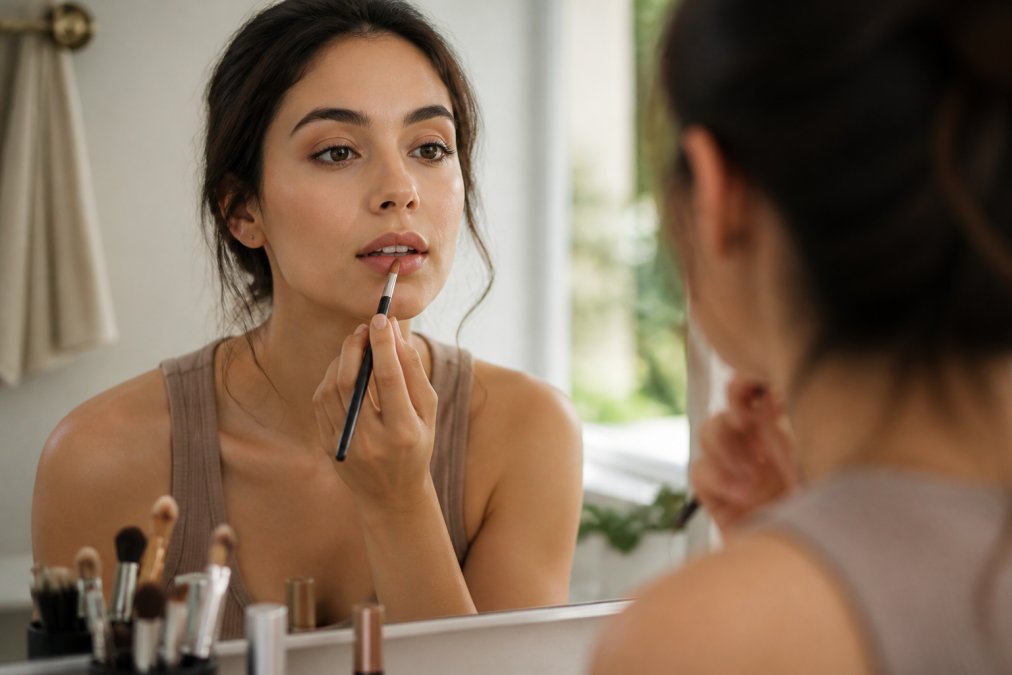
Lip Liner, Finish, and the 'Washed Out' Problem
Finish changes everything. Matte gives the longest wear and the most pigment, but it can flatten lips and emphasize texture. Satin balances color payoff with a soft sheen and works for most everyday situations. Sheer and gloss finishes feel lightest and look most natural, but they fade faster and need reapplication after meals.
The washed-out problem almost always traces back to one of three causes: a shade too light for your natural lip color, a gray-based undertone that clashes with your complexion, or a matte finish applied over dry, unexfoliated lips. Fix the shade first, then the finish.
Nude Lipstick for Mature Lips and Color Theory Beyond Undertones
Most guides stop at undertone. Two variables matter just as much, and almost no ranking article addresses either one properly: how lips change with age, and how contrast level, not skin tone, predicts whether a nude will look flat or finished.
Why Mature Lips Need a Different Nude
Lips thin with age, lose natural pigment, and develop vertical fine lines that catch color unevenly (PubMed). A nude that worked at 30 often reads anemic at 55, not because the shade changed but because the canvas did. Three adjustments fix most of it.
First, go one shade deeper than your natural lip, not lighter. Pale nudes make thinning lips recede further and flatten the mouth. A nude with slightly more depth restores the definition that natural pigment loss took away.
Second, choose satin or sheer over flat matte. Matte formulas settle into vertical lines and emphasize texture, which is the opposite of what mature lips need. Satin reflects a small amount of light, which visually plumps the lip and softens the look of fine lines. Sheer formulas let your own lip tone blend through, which reads more natural than any opaque shade can.
Third, prep differently. Exfoliation matters more on mature lips because dry flakes catch pigment unevenly and create patchy color. A thin layer of balm, blotted, then a lip liner that matches your natural lip color, not the lipstick, gives the color something to hold onto and prevents feathering into lines around the mouth.
A common pattern among makeup artists who work with mature clients: they reach for rose, soft berry, and warm mauve nudes rather than true beiges. These shades carry enough color to define the lip without reading as a bold lipstick, and they flatter the cooler, less saturated tones that mature skin often develops.
Contrast Level: The Variable Most Guides Skip
Color theory goes beyond undertones. Contrast is the missing variable. Contrast is the difference in depth between your skin, hair, and eyes, and it predicts a nude match more accurately than undertone alone.
If you have high contrast between your skin, hair, and eyes (think dark hair and fair skin, or deep eyes against light skin), a nude that is too close to your skin tone will look flat. You need a nude with slightly more depth or saturation to hold its own against your natural contrast. Low-contrast coloring, where skin, hair, and eyes sit in similar tonal ranges, handles softer, more muted nudes beautifully.
Color saturation matters too. Muted tones read as understated and elegant; vibrant tones read as bolder. For a true everyday nude, aim for the muted end of your undertone family. If you want the lip to register at all in a photo, move one step toward saturation, not toward a different undertone.
Here is the practical test. Hold your hand next to your face in daylight and squint. If your features blur together into one tonal mass, you are low contrast and should stay muted. If your eyes and hair pop against your skin, you are high contrast and need a nude with more depth than your instinct suggests.
Why Virtual Try-On Tools Fall Short (and How to Test in Store)
Virtual try-on tools are useful for ruling out shades, not for confirming them. The problem is calibration: your phone camera adjusts white balance automatically, your screen renders color differently from real life, and the tool has no way to account for your actual lip pigmentation underneath the digital overlay.
Use virtual try-on to build a shortlist of three or four candidates. Then test in person. In store, swatch each candidate on your bare lips, step to a window with natural daylight, and check the color in a hand mirror. Daylight is the only honest light for judging undertone. Store lighting is designed to flatter merchandise, not to tell you the truth.
If you are ordering online, look for brands that show swatches on multiple skin depths rather than a single model. Charmstyle Beauty Cosmetics's rusty nude lipstick is a warm, wearable option for medium and deeper skin depths, and the nude pink lipgloss offers a lighter, high-shine alternative for those who prefer sheer coverage.

Conclusion
Finding a nude lipstick that actually works comes down to three variables most shoppers never check: undertone, natural lip pigmentation, and contrast level. Get those right, and the shade almost picks itself.
Charmstyle Beauty Cosmetics builds lightweight, wearable lip products designed for exactly this kind of everyday, effortless wear. Our rusty nude lipstick delivers creamy, ultra-pigmented color with a velvety finish, while our NUDE PINK lipgloss gives you a sheer, hydrating wash of color for days when you want your natural tone to lead. Both are formulated to keep lips soft and comfortable through a full day, not just the first hour.
Start with your undertone, test in daylight, and build your routine around formulas that enhance what you already have.
Frequently Asked Questions
How do I know if a nude lipstick suits my skin tone?
Hold the tube next to your bare lips in daylight. If the shade blends with your natural lip color and doesn't make your face look gray or washed out, it works. Warm undertones pair best with peach, caramel, and honey nudes. Cool undertones match rose, mauve, and berry-tinged nudes. Neutral undertones can wear either. The goal is a shade one or two steps deeper than your lips, not lighter.
Should nude lipstick be lighter or darker than my lips?
Darker, or at most the same depth. A nude lighter than your natural lip color flattens your features and creates that washed-out look. Choose a shade one to two steps deeper than your bare lips. If you want extra definition, line with a pencil that matches your lip color, then apply the lipstick over it. This keeps the result natural while giving your mouth visible shape.
What is the difference between cool and warm nude lipsticks?
Cool nudes have pink, mauve, or berry bases. Warm nudes lean peach, caramel, or brown. The difference shows up fast: a cool nude on warm skin looks ashy, and a warm nude on cool skin turns orange. Swatch on your inner wrist, not your hand, and check in daylight. If the shade disappears into your skin, it's the wrong temperature.
Can anyone wear nude lipstick?
Yes, but 'nude' is personal. It means the shade closest to your own lip pigment, not a single beige tone. Deeper skin tones often find their best nude in rich caramel, chestnut, or chocolate shades. Fair skin may need a soft rose or peachy pink. The mistake is copying someone else's nude. Test shades against your bare lips before committing.