

Last Updated: October 29, 2026
Quick Summary
Sustainable lip packaging depends on three things: the material, the format, and whether the package can actually be recycled where you live. Post-consumer recycled plastic, mono-material designs and refillable cases are the most credible options, while vague "eco" or "compostable" claims often hide narrow or unverified benefits.
- Check which component the recycled content applies to and whether it is post-consumer.
- Mono-material tubes can be recycled as one stream, making them the most credible recyclability claim.
- Small lip gloss tubes often fall through sorting screens at recycling facilities.
- Refillable cases only reduce waste if you buy refills and the refill costs less than a new product.
- Ask brands which disposal route a claim assumes before trusting words like compostable.
Table of Contents
- Why Lip Packaging Is Harder to Make Sustainable Than It Looks
- Sustainable Packaging Materials Used in Lip Cosmetics
- Refillable Lipstick Packaging and Reuse Economics
- Recyclable Lip Gloss Packaging: Small Formats and Real-World Recycling
- Plastic-Free Lipstick Packaging: Metal, Paperboard and Trade-Offs
- How to Check a Lip Product's Packaging Claims Before You Buy
- Choosing Your Next Lip Product: Where Charmstyle's Packaging Fits
- Frequently Asked Questions
Why Lip Packaging Is Harder to Make Sustainable Than It Looks
Sustainable lip packaging is harder to get right than most shoppers assume. A lipstick or gloss tube is small, often mixes several materials, and has to protect a product that spoils, leaks or smears if the seal fails. Packaging is part of the product, not an afterthought, and it is worth being careful about what any brand claims.
The difficulty is that the most eco-friendly-sounding option is not always the most sustainable one in practice. A tube that looks minimal can still be hard to recycle, and a material that sounds natural can carry a larger footprint once you account for production and transport. Sustainable packaging trends in lip cosmetics are real, but they are uneven, and the labels do not always tell you which trade-off you are getting.
This guide walks through the materials, formats and claims behind sustainable lip packaging so you can judge a product on evidence rather than marketing. Here is the short version: a package is only as sustainable as its material, its format and whether it can actually be recycled where you live.
Sustainable Packaging Materials Used in Lip Cosmetics
Most lip products use a handful of packaging materials: virgin plastic, recycled plastic, paperboard, metal and bioplastics. Each one solves a different problem. Plastic is light, cheap and protective. Metal feels premium and is durable. Paperboard reads as natural but usually needs a barrier layer to protect the formula.
The materials you will see most often are post-consumer recycled (PCR) plastic, biobased and biodegradable polymers, and mono-material designs that use one plastic throughout so the package can be recycled as a single stream. Refillable formats are a separate category, because the sustainability gain comes from reuse rather than from the material itself.
PCR Plastic Cosmetic Packaging: What the Recycled Content Figure Means
PCR plastic is made from material collected after consumers have used it, such as recycled bottles. A package labeled with a recycled content percentage is telling you how much of the material came from that waste stream. A 50% figure means half the plastic is recycled, not that the whole package is.
Read the percentage with two questions in mind. Is it post-consumer or post-industrial? Post-industrial scrap from a factory floor is recycled, but it never reached a consumer, so it is a weaker environmental claim. And does the figure apply to the whole package or only one component, such as the outer case while the applicator is virgin plastic?
Ask the brand directly which component carries the recycled content. Vague wording like "made with recycled materials" usually means the claim is narrow.
Biobased and Biodegradable Options: Where the Claims Break Down
Biobased plastics are made partly or fully from plant material, while biodegradable materials are designed to break down under certain conditions. These are different properties. A biobased plastic may not biodegrade at all, and a biodegradable package may only break down in an industrial composting facility that most households cannot reach.
Be cautious with words like "compostable" and "eco-friendly" on a lip product. They often describe conditions that do not exist in ordinary waste collection. Check whether the claim names a standard and a disposal route. If it does not, treat the claim as unverified.
Refillable Lipstick Packaging and Reuse Economics
Refillable lipstick packaging keeps a durable outer case and replaces only the inner refill. The environmental logic is simple: fewer new cases are made and fewer empty shells are thrown away. The savings depend on whether you actually buy refills and whether the refill costs less to make and ship than a whole new tube.
The economics are not automatic. A refill system only reduces waste if the refill uses less material than the original product and the customer completes the cycle. For a brand, refills also have to be priced so they feel worth buying. Ask whether a refill is priced below a full product and whether the case is built to last through many refills rather than being sold as a single-use keepsake.
Recyclable Lip Gloss Packaging: Small Formats and Real-World Recycling
Small lip gloss tubes are difficult to recycle, but the reason is more mechanical than most shoppers realize. Municipal recycling programs are built around larger bottles and containers, and the equipment that sorts them, screens, air classifiers, optical sorters and magnets, is calibrated for items that behave in predictable ways. A lip gloss tube is small, light and often multi-material, which means it can fall through screens, get mis-sorted, or be pulled off the line as residue.
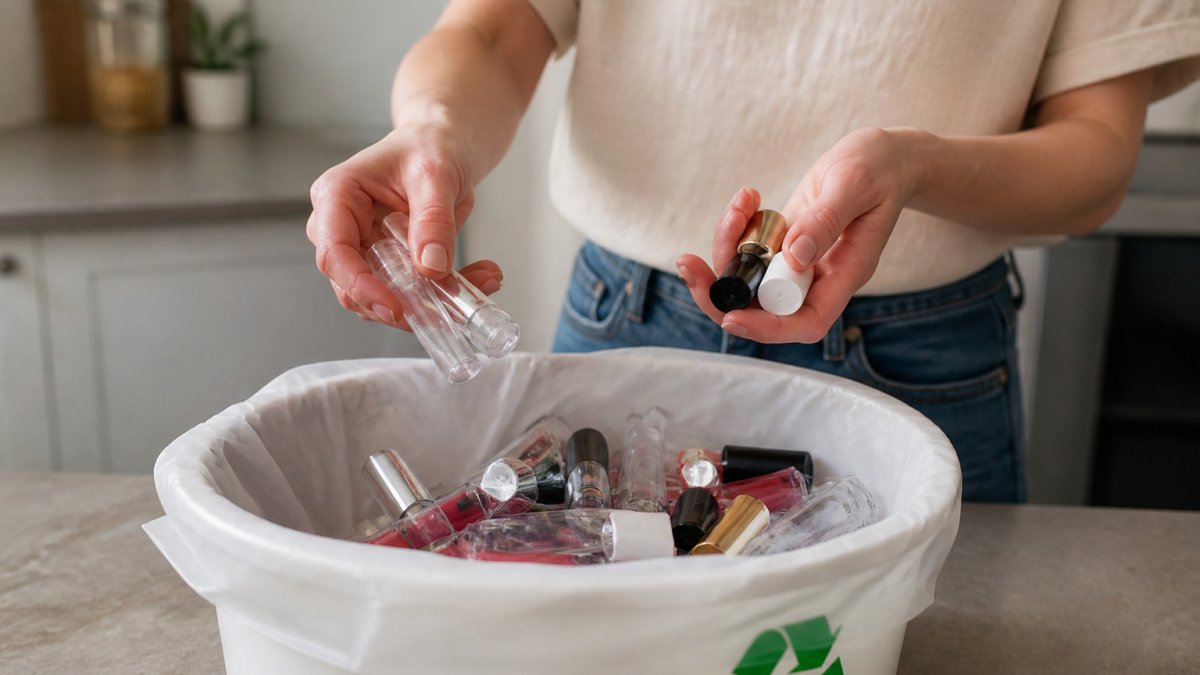
The size problem is the first hurdle. Many materials recovery facilities (MRFs) use a rule of thumb that items smaller than roughly two to three inches in two dimensions are too small to sort reliably, so they drop through the screen and end up in the residue stream. A standard lip gloss tube is often in that range. That is why a tube can carry a recycling symbol and still not be recovered in practice.
CHARMSTYLE BEAUTY NUDE LIPSTICK →
The second hurdle is mixed materials. A typical gloss package combines a plastic tube, a plastic or elastomer cap, a thermoplastic elastomer wiper, a plastic or metal applicator rod, and sometimes a metal or glass component. Each material has a different density and magnetic response, so a single package can be split across multiple sorting streams, or, more often, sent to landfill because no single stream claims it.
Magnets and mirrors make it worse. A compact or a lip product with a mirror and a magnetic closure introduces metal and glass into a plastic-dominated package. Magnets can trip metal detectors and eddy-current separators, and mirrors are usually glass or coated plastic that contaminates the plastic stream. Unless the consumer separates the parts, the whole package is likely to be rejected.
Residual product is the third hurdle. A tube with gloss still clinging to the walls is contaminated by definition. Most programs ask consumers to scrape out as much product as possible and to leave the cap on or off according to local rules, but a wiper coated in gloss is hard to clean and often disqualifies the tube from rigid plastic recycling.
What actually improves recovery:
- Mono-material design. A tube, cap and wiper made from the same plastic resin can be recycled as one stream, which is why mono-material formats are the most credible recyclability claim in lip packaging.
- Detachable components. A cap that twists off and a wand that pulls out let the consumer separate plastic from metal or glass before disposal.
- Size-aware design. A slightly larger tube or a tube designed to be nested with others is easier for MRFs to capture than a very small, light item.
- Clear on-pack instructions. A label that names which part is recyclable and which is not is more useful than a bare recycling symbol.
For shoppers, the practical test is simple: can you separate the parts, is the main body one material, and does your local program accept small rigid plastics? If the answer to any of those is no, the package is more likely to go to landfill than to a new product.
Plastic-Free Lipstick Packaging: Metal, Paperboard and Trade-Offs
Plastic-free lipstick packaging usually means metal, paperboard or glass. Metal tubes and tins are durable and widely recyclable in many areas, which makes them a strong option when they are built to be reused. You can see one example of a tube-style lip product on the CHARMSTYLE BEAUTY KIWI LIPSCRUB page. Paperboard feels natural, but it often needs a plastic or coated liner to keep the formula sealed, so "plastic-free" can still contain plastic.

Look at the full package, not just the outer label. A paper case with a plastic insert is a different product from a fully paper-based one. Ask what protects the formula and whether that protective layer can be separated for recycling.
How to Check a Lip Product's Packaging Claims Before You Buy
Start with the specific claim, not the general impression. A label that says "recyclable" should tell you what part is recyclable and where. A label that says "recycled" should give a percentage and name the material. Vague sustainability language is the most common sign that a claim is not backed by much.
Use this short check before you buy:
- Which component is the claim about: the tube, the cap, the applicator or the whole package?
- Is any recycled content post-consumer, and what percentage is it?
- Does the package use one material or several that have to be separated?
- Does the claim name a disposal route you can actually use?
- Is there a refill option, and is it priced to make reuse worth it?
If a brand cannot answer these questions clearly, the packaging is probably less sustainable than the front of the box suggests.
Choosing Your Next Lip Product: Where Charmstyle's Packaging Fits
When you choose your next lip product, weigh the packaging against how you will use it. A durable metal or refillable case may be worth the higher upfront cost if you keep buying the same shade. A simple mono-material tube may be the better pick if you want a lightweight product you can recycle without fuss. Neither format is automatically better; the right choice depends on how long you keep the product and whether your local recycling accepts it.
Charmstyle Beauty Cosmetics focuses on effortless everyday lip beauty. If you are comparing options, you can browse the Charmstyle Beauty Cosmetics lip products to find formats that suit your routine.
Frequently Asked Questions
What is the most sustainable packaging for lip products?
There is no single best option. Refillable outer cases paired with a replaceable inner refill generally reduce the most material per use, because the durable housing is kept. Mono-material tubes that can be recycled where your local program accepts them are a practical second choice. Metal tins can last a long time but are heavier and carry more embodied impact per unit. The right answer depends on the product format, how often you would refill, and whether your local recycling program accepts the specific material. Check the material and the disposal instructions on the packaging before deciding.
Are refillable lipstick tubes better for the environment?
Often, yes, but only if the refill is actually used. A refillable case avoids discarding the outer housing every time you finish a shade, which removes a large share of the packaging waste. The benefit shrinks if the refill pod is itself hard to recycle or if the case is replaced before it is worn out. Look for refills that use less material than the original and for a housing made from durable plastic or metal that you expect to keep for several purchases.
Can lip gloss tubes be recycled?
Many lip gloss tubes cannot be recycled through curbside programs. Their small size, mixed materials such as a plastic body with a metal wand or a multi-layer tube, and residue from the product all make sorting difficult. Some tubes made from a single plastic type may be accepted in certain programs. Empty the tube as fully as you can, check whether the brand lists a take-back option, and confirm with your local waste authority before placing it in the bin.
What does PCR mean in cosmetic packaging?
PCR stands for post-consumer recycled. It describes plastic that was made from packaging already used by consumers and collected for recycling, then reprocessed into new packaging. A packaging component labeled as containing a certain percentage of PCR content should state that percentage clearly. Higher PCR content reduces demand for virgin plastic, but it does not automatically make the package recyclable again, and food-contact or cosmetic-grade requirements can limit how much recycled material can be used in a given part.
