

Table of Contents
- Why Lipstick Feathers and Bleeds Into Fine Lines
- The Best Lip Liner to Prevent Lipstick Bleeding
- Lip Primer for Lipstick Feathering: Does It Work?
- How to Apply Lip Liner With Lipstick for a Clean Edge
- How to Prevent Lipstick From Fading Through the Day
- Step-by-Step Routine: Prep, Line, Prime, Seal, Set
- Troubleshooting: Why Your Lipstick Still Feathers
- Frequently Asked Questions
Last Updated: October 12, 2026
Why Lipstick Feathers and Bleeds Into Fine Lines
Lipstick feathering is the spread of color beyond your natural lip line into the tiny lines around your mouth. At Charmstyle Beauty Cosmetics, we hear this complaint constantly, and how to prevent lipstick from feathering is simpler than most people think.

The good news: feathering is preventable. You just need the right prep, the right products, and the right order of steps.
Here is the core problem. Your lips have a natural border called the vermilion border. Around it sit small lines and creases. Some are from genetics. Some come with age. Some show up when lips are dry.
What Causes Color Migration
Color migration comes down to three things: texture, moisture, and formula.
- Dry, flaky lips give pigment uneven ground to grip. It slides into cracks.
- Oily or slippery products act like a lubricant for color.
- Thin, runny formulas travel farther than thick, matte ones.
The American Academy of Dermatology notes that lips have no oil glands, which makes them prone to dryness and cracking (American Academy of Dermatology on lip care). Dry lips and feathering go hand in hand.
So the fix starts before color ever touches your mouth.
The Best Lip Liner to Prevent Lipstick Bleeding
The best lip liner to prevent lipstick bleeding is a matte, waxy pencil that matches your lip color or your lipstick shade. Matte pencils create a dry barrier. Creamy or glossy liners do not.
Here is what to look for:
- Matte or semi-matte finish for a firm barrier
- Firm texture that does not skip or drag
- A shade close to your natural lip color for a seamless edge
Skip lip liners that feel like lip balm. They add slip, and slip is the enemy here.
One more thing. A liner that is too dark creates a harsh ring. Match it to your lips, not your lipstick, unless you want a defined look on purpose.
Lip Primer for Lipstick Feathering: Does It Work?
Yes, a lip primer for lipstick feathering works, but only if you use it correctly. Primer fills in fine lines and creates a base that grips color. It also blocks the natural moisture that pushes pigment outward. Smoothing the skin texture before application serves as a foundational step to prevent fine lines from deepening over time.
Primers come in three main types:
| Primer Type | Best For | How It Helps |
|---|---|---|
| Wax-based balm | Dry lips | Fills lines, adds grip |
| Silicone-based | Oily lips | Creates a smooth, dry barrier |
| Matte liquid | Long-wear looks | Locks color in place |
Apply a thin layer and let it set for a minute. Then blot off any excess. Too much primer makes color slide.

How to Apply Lip Liner With Lipstick for a Clean Edge
Here is how to apply lip liner with lipstick for a clean edge: line first, fill second, then apply color on top.
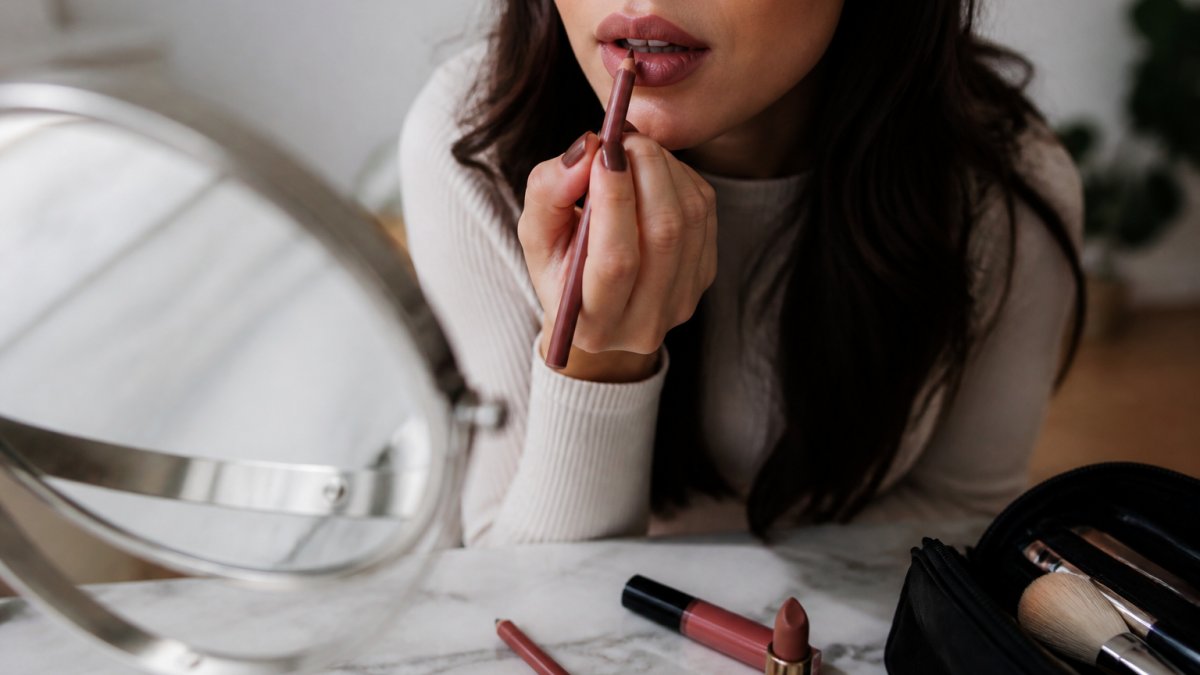
Start at the center of your cupid's bow. Draw short strokes outward toward each corner. Do not stretch your mouth.
Then fill in the entire lip with liner, not just the edge. This gives lipstick something to hold onto.
Lining Inside vs. Outside the Natural Lip Line
Line inside the natural lip line for everyday wear. Line just on the line for a defined edge. Only go slightly outside if you want to build shape, and never more than a hair's width.
Going too far outside is the fastest way to look like color is bleeding. The line should trace your real border, not float above it.
How Liner Behavior Changes by Lipstick Formula
Most guides treat lip liner as one universal step. It is not. The liner that saves a matte bullet can wreck a glossy one, and the technique that works for a liquid lipstick can look chalky under a cream finish.
| Lipstick Formula | Liner Finish to Use | Technique Note |
|---|---|---|
| Traditional cream bullet | Semi-matte pencil | Line and fill; cream color glides over the liner without dragging |
| Matte bullet | Matte or semi-matte pencil | Line thin; a heavy liner layer under matte color can look dry and crack |
| Liquid matte | Matte pencil, applied sparingly | Fill only the outer third; liquid formula grips the center on its own |
| Gloss or sheer tint | Matte pencil as a base only | Skip filling the whole lip; gloss will slide over a fully lined lip |
| Long-wear transfer-proof | Matte pencil, minimal | Many long-wear formulas already resist migration; too much liner causes pilling |
A common pattern is that people buy one liner and use it with every lipstick they own, then blame the lipstick when the edge fails. The liner is doing half the work.

Choosing Between Liner, Primer, and Other Barriers
If you are not sure which barrier to reach for, use this decision guide.
- Mild feathering, creamy lipstick, normal lips: a matte lip liner alone is usually enough. Skip primer to avoid a heavy feel.
- Moderate feathering, any formula, fine lines around the mouth: pair a matte liner with a thin layer of wax-based primer. The primer fills lines; the liner holds the edge.
- Severe feathering, oily skin or oily lip area: use a silicone-based primer first, then a matte liner. Oil breaks down wax, so the silicone barrier does the heavy lifting.
A Note on Liner Shade
A liner that is too dark creates a harsh ring. Match it to your lips, not your lipstick, unless you want a defined look on purpose. If you want a slightly fuller look, choose a liner one shade deeper than your natural lip and blend the inner edge with your fingertip before applying color.
How to Prevent Lipstick From Fading Through the Day
To prevent lipstick from fading, you need to seal and set it. Fading and feathering are cousins. Both come from formula that never bonded to your lips.
Try this:
- Blot after the first coat with a tissue
- Dust translucent setting powder over the tissue
- Apply a second thin coat
Carry a matching liner for touch-ups. Re-lining the edge mid-day is faster than redoing the whole lip.
Step-by-Step Routine: Prep, Line, Prime, Seal, Set
Follow this order every time and you will know how to prevent lipstick from feathering, because the color mostly stays put.
- Exfoliate dry, flaky lips with a soft cloth or sugar scrub.
- Moisturize with a light lip balm, then blot off the excess.
- Prime with a thin layer of matte lip primer.
- Line the natural lip line with a matte pencil.
- Fill the whole lip with liner.
- Apply your lipstick or liquid lipstick.
- Blot with a tissue.
- Set with a light dust of translucent powder.
- Seal the edge with a clean liner pass.
For long-wear days, reach for a matte liquid lipstick. Our Pink Lemonade Liquid Matte Lipstick dries down to a smudge-proof finish that resists transfer.
The Charmstyle Beauty Lip Kit gives you bold, highly pigmented color with a creamy, smudge-resistant finish.
Troubleshooting: Why Your Lipstick Still Feathers
If color still creeps, one of these is usually the cause. Work through them in order, the first one that matches your situation is almost always the culprit.
Step 1: Check What Is Under the Lipstick
- You skipped primer and used balm instead. Balm adds slip.
- You over-moisturized. Too much balm pushes color outward. Blot before color, every time.
- Your primer is oil-based. Oil breaks down wax and pigment, and the color travels within an hour.
Step 2: Check the Liner
- Your liner is too creamy. Creamy liners melt and travel. Switch to a matte or semi-matte pencil.
- You lined outside the edge. Extra liner gives color a runway.
- Your liner shade is much darker than your lipstick. This does not cause feathering, but it makes any minor migration look worse.
Step 3: Check the Formula
- Your formula is thin. Sheer glosses and tints migrate more than matte bullets or liquid mattes.
- Your formula and liner are incompatible. A silicone-based primer under a wax-based liner can cause the liner to slide. A heavy matte liner under a liquid matte can cause pilling at the edge.
- Your long-wear formula is drying out your lips. Dryness creates cracks, and cracks pull pigment sideways. This is the trade-off most guides ignore.
Step 4: Check the Lips Themselves
- Your lips are dry underneath. Cracks pull pigment sideways.
- You have deep vertical lines above the lip line. These are genetic or age-related, and no liner fully blocks them. Primer is the better tool here.
- You have oily skin around the mouth. Oil migrates up into the lip line over the course of the day. A silicone-based primer and a mid-day blot help.
Quick Fix Guide
| Problem | Likely Cause | Quick Fix |
|---|---|---|
| Color creeps within an hour | Oily balm underneath | Blot, add matte primer |
| Edge looks fuzzy | Creamy liner | Switch to matte pencil |
| Fades after eating | No setting step | Blot and powder |
| Dry, cracked lips | No exfoliation | Scrub and moisturize |
| Color pills at the edge | Primer and liner incompatible | Drop the primer, keep the liner |
| Feathering returns by mid-day | Oily skin around the mouth | Blot, re-line the edge only |
Sensitive Skin and Ingredient Considerations
Sensitive or easily irritated lips need extra care. Look for fragrance-free formulas and patch test new products first. Harsh ingredients can dry lips further, which makes feathering worse over time.
A practical patch test: apply a small amount of the new liner or primer to the outer corner of your lip, wait 24 hours, and check for redness, tingling, or flaking.
For more on lip product safety and ingredients, the U.S. Food and Drug Administration cosmetics information outlines what to check on labels.
The Long-Wear Trade-Off
Long-wear and transfer-proof lipsticks resist feathering better than any other formula, but they are also the most drying. Over time, that dryness creates the cracks that cause feathering in the first place. A balanced routine looks like this:
- Wear long-wear formulas on days when you need them, not every day.
- Remove them with an oil-based cleanser or balm, not a wipe. Wipes tug at the lip and worsen dryness.
- Follow removal with a fragrance-free lip balm and let it sit overnight.
If you want a shade that stays put without the fuss, the Scarlet Charm Matte Liquid Lipstick offers a soft matte finish with long wear. And the Charmstyle Beauty Lipstick Bundle covers three shades so you can match your formula to any occasion.
Frequently Asked Questions
What is the best lip liner to prevent lipstick bleeding?
A matte, waxy lip liner that matches your natural lip color or your lipstick shade works best. Apply it along the natural lip line, then fill in the entire lip before adding lipstick. This creates a barrier that stops color from migrating into fine lines.
Can lip primer help prevent lipstick from feathering?
Yes. A lip primer for lipstick feathering creates a smooth base that fills in fine lines and gives lipstick something to grip. Apply a thin layer over clean, dry lips and let it set for about 30 seconds before adding color. Primers with a matte finish tend to work best for feather-prone lips.
Why does my lipstick still feather even with liner?
Several factors can cause this. Another issue is liner that is too soft; it slides instead of creating a barrier. Also check whether your lip balm is too slippery underneath.
How do I keep lipstick from fading quickly?
Start with exfoliated, moisturized lips, then apply a thin layer of lip primer. Line and fill your lips with liner before lipstick. After applying lipstick, blot with a tissue and reapply for longer wear. Choose a long-lasting or matte liquid lipstick formula when you need extra staying power. A touch-up after meals is normal for most formulas.
Feathering does not have to ruin your look. With the right prep, a matte liner, and a setting step, color stays where you put it.
At Charmstyle Beauty Cosmetics, our lightweight, wearable formulas are built for everyday confidence. From our smudge-resistant matte liquid lipsticks to our hydrating lip kits, each product is designed to elevate your natural glow with ease.
Get started with Charmstyle Beauty Cosmetics and keep your lip color clean, comfortable, and in place all day.