

Table of Contents
- Why Finding the Right Lipstick Shade Online Is Tricky
- How to Identify Skin Undertone Before You Shop
- How to Choose Lipstick for Skin Tone and Depth
- Use Virtual Lipstick Try-On Tools the Right Way
- Match the Finish to Your Look: Matte vs. Satin vs. Glossy
- Read Product Descriptions for Formula Clues
- Common Mistakes to Avoid When Buying Lipstick Online
- Conclusion
- Frequently Asked Questions
Last Updated: September 7, 2026
Buying lipstick online is a gamble. Learning how to choose lipstick shade online comes down to understanding your skin's undertones, reading formulas like a label, and using virtual tools with realistic expectations. This guide from Charmstyle Beauty Cosmetics breaks down the exact process so your next shade is a match, not a return.
The core problem is that screens lie about color. A lipstick that looks like a soft rose on one monitor can appear as a deep berry on another, and every brand photographs its shades under flattering studio lighting.
Why Finding the Right Lipstick Shade Online Is Tricky
The biggest obstacle to finding the right lipstick shade online is the gap between what your screen shows and what the product actually looks like on your lips. Digital color reproduction varies by device, brightness, and even the angle you hold your phone (sciencedirect.com). Research on digital color perception confirms that the same hex value renders differently across common consumer displays.
Your lips also have their own natural pigmentation. A sheer formula blends with your base color, while an opaque one covers it entirely. This is why a shade that looks stunning on an influencer with fair skin can look completely different on a deeper complexion. The swatch is a starting point, never a guarantee.
How to Identify Skin Undertone Before You Shop
Your undertone is the subtle color beneath your skin's surface, and it determines which shades will harmonize with your complexion. How to identify skin undertone is the single most valuable skill you can learn before shopping for makeup online. It is not about how light or dark your skin is; but whether your base hue leans warm, cool, or neutral.
The Vein Test and Jewelry Test Explained
Two simple tests help determine your undertone at home. The vein test involves looking at the veins on the inside of your wrist in natural light. If they appear blue or purple, you likely have cool undertones. If they look green, you are warm-toned. A mix of both suggests neutral undertones.
The jewelry test is equally straightforward. Hold gold jewelry against your skin, then silver. Warm undertones tend to glow in gold, while cool undertones look brighter in silver. If both metals look fine, you are probably neutral. These tests are not scientific absolutes, but they provide a dependable baseline.
The Missing Variable: Skin Depth
Most online guides stop at undertone, which is why so many shoppers still end up with a shade that looks 'off.' Undertone tells you the color family, but skin depth, how light or deep your complexion is, determines the intensity and saturation of the shade you need. A fair-skinned person with cool undertones needs a sheer, blue-based pink, while a deep-skinned person with the same undertone needs a highly pigmented berry with the same blue base.
A practical way to gauge your depth is to compare the inside of your forearm to a set of foundation shades in a drugstore or on a brand's website. Most major brands like Fenty Beauty, MAC, and NARS organize their shade ranges by depth levels (e.g., 100-490 in Fenty's Pro Filt'r line). Find the depth level that disappears into your skin, then use that number as a reference point when browsing lipsticks.
The Paper Bag Test Is Outdated, Use the White Paper Test Instead
A common but flawed method circulating online is the 'paper bag test,' which compares skin to a brown paper bag. This is rooted in colorism and has no place in modern shade matching. A better, color-theory-based approach is the white paper test. Hold a plain white sheet of paper next to your bare face in natural light. If your skin looks yellow or golden next to the white, you are warm-toned. If it looks pink, rosy, or blue-ish, you are cool-toned. If it looks gray or olive, you are neutral.
Why Undertone Tests Fail on Screens
Vein and jewelry tests require you to look at your actual skin, not a photo. A phone camera auto-adjusts white balance, and most screens boost saturation, which can make warm skin look cooler or vice versa. Do these tests in a mirror, in natural daylight, with no makeup on. If you must use a photo, take it with a neutral gray card or a piece of white paper in the frame, then use a photo editing app to check the RGB values of your skin, a higher red value suggests warm undertones, a higher blue value suggests cool.
The 3-Zone Check for Accuracy
Your wrist is not the only place to check undertone. For lipstick specifically, the color of your lips and the skin around your mouth matters more than your wrist. Check the area just below your lower lip, this zone often reveals a truer undertone for lip color matching. If the skin there looks yellowish, lean warm; if it looks pinkish, lean cool.
What If You Are Truly Neutral?
Neutral undertones are not a myth, but they are less common than the internet suggests. Most people lean slightly warm or slightly cool. If you genuinely cannot tell after multiple tests in different lighting, you are likely neutral. For neutrals, look for colors described as 'mauve,' 'rosewood,' or 'dusty pink.' These contain both pink and brown pigments, which harmonize with a neutral base without pulling too orange or too blue. Avoid extremes: a bright orange-red or a stark blue-red will both look disconnected on a true neutral.
How to Choose Lipstick for Skin Tone and Depth
Once you know your undertone, how to choose lipstick for skin tone becomes a matter of matching depth and hue. A deep complexion with cool undertones needs a very different berry than a fair complexion with the same undertone.
For warm undertones, coral, peach, and brick-red shades add a natural glow. Cool undertones shine in blue-based reds, rose, and berry tones. Neutral undertones can pull off most colors, but nude shades with a balanced mix of pink and brown tend to look most effortless.

Use Virtual Lipstick Try-On Tools the Right Way
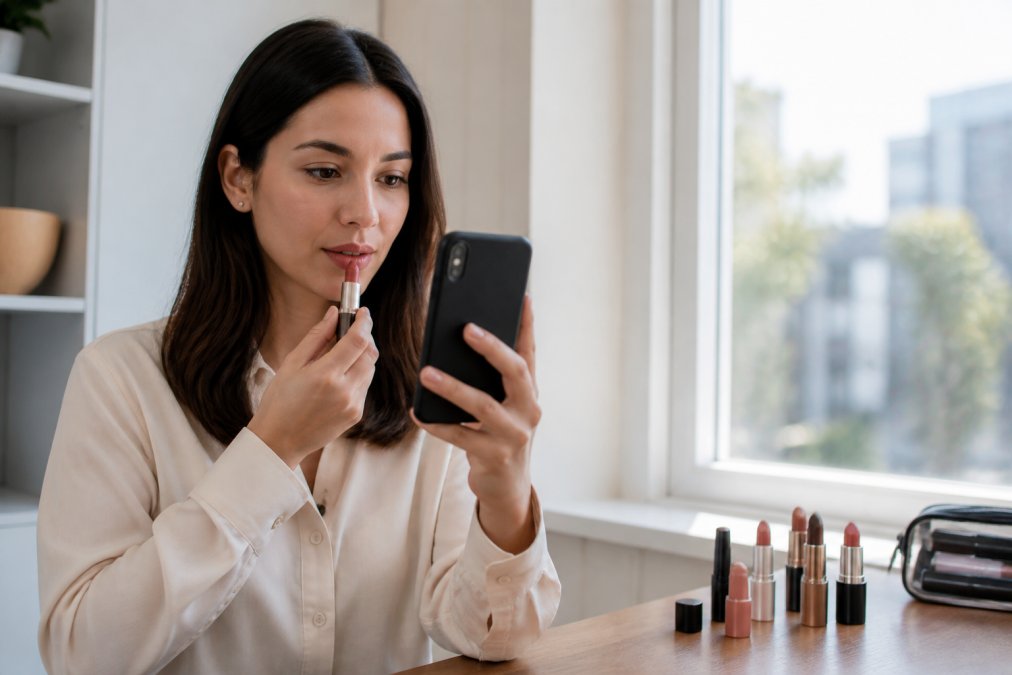
Virtual lipstick try on tools are helpful, but they have limits. These apps use augmented reality to map color onto your lips in real time, and they are excellent for narrowing down color families. However, they often render shades with a digital smoothness that real lipstick does not have, and color accuracy depends heavily on your camera and lighting.
To get useful results, use the tool in consistent, natural light. Avoid direct sunlight and harsh overhead bulbs. Stand facing a window, hold your phone at eye level, and test shades one at a time. Take a screenshot, then compare it against the brand's official swatch photos to spot discrepancies.
Calibrate Your Screen for True Color
Your screen's settings distort every shade you view. Most phones default to a vivid mode that boosts saturation, making lipsticks look brighter and more intense than they really are. Before you trust any swatch, adjust your display to a standard color profile or reduce the saturation boost.
On most devices, these settings are under Display and Brightness. Turning on True Tone or Night Shift changes color temperature, so disable those during your shopping session. A calibrated screen shows you the actual pigment, not an enhanced version.
The 3-Screen Cross-Check Method
The single most effective technique for online shade selection is to view the same lipstick on three different screens: your phone, your computer monitor, and a tablet if you have one. Each device renders color differently due to panel technology (OLED vs. LCD) and factory calibration. If a shade looks like a true red on all three screens, you can trust it. If it looks orange on one and pink on another, the product photos are likely edited, and the real shade sits somewhere in between.
How to Read a Virtual Swatch Like a Pro
Virtual try-on tools show you color on your lips, but they do not show you texture, opacity, or how the formula will wear. When you test a shade virtually, pay attention to three things:
- Coverage: Does the tool show your natural lip line bleeding through, or is the color fully opaque? If the tool renders full opacity, the real product will likely be more sheer unless the formula is explicitly labeled 'full coverage.'
- Sheen: Does the virtual swatch have a glossy highlight? If so, the real product may be less shiny, especially if it is a matte formula. The tool often adds a uniform gloss that real lipstick does not have.
- Edge blending: Look at how the color sits at the border of your lips. Virtual tools often blur this line. In reality, a poorly matched shade will create a visible 'ring' around your lips. If the virtual swatch looks harsh at the edges, it will look worse in person.
Why Virtual Tools Fail on Deep Skin Tones
A known limitation of many AR try-on tools is that they are calibrated on lighter skin tones. The camera's auto-exposure often washes out deeper complexions, making lipstick shades appear lighter or more muted than they are. If you have deep skin, use the tool to narrow down to two or three shades, then search for those exact shades on social media platforms like TikTok or Instagram using the hashtag followed by your foundation shade range (e.g., '#Fenty400 lipstick'). Real user videos in natural lighting are a more reliable reference than any AR filter.
The 'Wrong Shade' Protocol: What to Do When It Arrives
Even with perfect technique, you will occasionally order a shade that misses. Before you buy, check the retailer's return policy. Sephora and Ulta Beauty both accept returns on used cosmetics within 30 to 60 days, but drugstore chains like CVS and Walgreens have stricter policies that may only allow exchanges on unopened items. If you are stuck with a shade that is too dark, mix it with a lighter lip balm or a white lip pigment to sheer it out. If it is too light, layer it over a deeper liner. If the undertone is wrong, neutralize it by layering a complementary shade over it. A blue-based red can cool down an orange-toned lipstick; a warm brown can warm up a too-cool pink. This 'lipstick mixing' approach turns a failed purchase into a custom shade.
The Lighting Trap: Why Your Bathroom Mirror Lies
Virtual tools are only half the equation. When your lipstick arrives, you will likely test it in your bathroom, which has the worst lighting for color evaluation. Overhead vanity bulbs cast warm or cool shadows that distort the shade. The gold standard is to check the color in three lighting conditions: direct sunlight, indoor fluorescent, and warm indoor light. A shade that works in all three is a keeper. If it only works in one, it will look wrong most of the day.
Match the Finish to Your Look: Matte vs. Satin vs. Glossy
The finish changes how the color reads on your lips, so it matters as much as the shade itself. A matte finish delivers full coverage with a flat, velvety look that lasts longest but can emphasize dry patches. A satin finish offers a soft sheen with moderate staying power, making it a forgiving choice for most wearers. A glossy finish adds shine and dimension but fades fastest and offers sheerer coverage.

A matte finish suits long workdays where you cannot reapply often. Satin works for everyday wear, and glossy is ideal for quick errands or evenings when you want a fresh, hydrated look. The same color in three finishes creates three entirely different impressions.
Read Product Descriptions for Formula Clues
Product descriptions contain hidden clues about how a shade will perform on your lips. Words like "sheer" signal buildable color that lets your natural pigmentation show through. "Opaque" or "full coverage" means the color will look close to the swatch. "Pigmented" suggests one swipe delivers intense payoff, while "buildable" means you control the depth.
Texture words matter too. A formula described as "creamy" typically glides on smoothly but may settle into lines. A "weightless" formula prioritizes comfort, and "long-wear" usually indicates a drier texture that stays put. Matching the formula to your lip condition is as important as matching the shade to your skin.
Common Mistakes to Avoid When Buying Lipstick Online
Most shade mismatches trace back to a few predictable errors. The first is relying on a single swatch photo taken under studio lighting. The second is ignoring your undertone entirely and picking colors based on trends. The third is forgetting that your natural lip color will alter sheer formulas.
Another frequent mistake is skipping the ingredient list when you have sensitive or dry lips. A shade you love is unwearable if the formula irritates you. Many brands now formulate with nourishing ingredients that keep lips comfortable, and the difference between a moisturizing base and a drying one is immediately noticeable. Guidance on cosmetic labeling and claims requires brands to list ingredients, so check for potential irritants before you order.
| Mistake | What Goes Wrong | The Fix |
|---|---|---|
| Trusting one studio swatch | Color looks different in real life | Cross-check with customer photos |
| Ignoring undertone | Shade clashes with complexion | Run the vein and jewelry tests first |
| Choosing the wrong finish | Matte emphasizes dry lips | Match finish to your day and lip condition |
| Picking a shade too light or dark | Color looks disconnected from your face | Stay within your skin's depth range |
Conclusion
Choosing the right lipstick shade online is a skill you can master with the right approach. Start with your undertone, respect your skin's depth, use virtual tools with calibrated expectations, and read the formula clues before you click buy. At Charmstyle Beauty Cosmetics, our curated selection of effortless lip beauty products is designed to enhance your everyday confidence. Our lightweight, wearable glosses, lipsticks, and stains are crafted to elevate your natural glow with ease. Whether you are looking for a subtle nude or a bold berry, our collection provides the perfect finishing touch for your daily look.
Frequently Asked Questions
How do I know which lipstick shade suits me online?
Start by determining your skin undertone using the vein or jewelry test, then match shades to that undertone. Use virtual try-on tools to preview the color on your face, but calibrate your screen brightness first for accurate results. Look for product descriptions that mention undertone compatibility, and check customer photos with similar skin tones before committing.
Are virtual lipstick try-on tools accurate?
Virtual try-on tools are useful for narrowing down your options, but they are not 100% accurate. Factors like your screen's color calibration, lighting conditions, and the tool's color-matching software can shift the appearance of the shade. Use them to rule out colors that clash with your undertone, then verify the final choice by reading reviews or checking swatches from users with a similar complexion.
What is the best way to test a lipstick shade without buying it?
Look for brands that offer shade finder quizzes or sample sizes. Customer review photos are also valuable because they show the lipstick on real skin in various lighting conditions. Pay attention to reviews that mention your specific undertone, and check the return policy before you order.
Get started with Charmstyle Beauty Cosmetics and find a lipstick that enhances your natural confidence. Explore our Charmstyle Beauty Cosmetics lipstick collection to shop shades matched to your undertone, with nourishing formulas built for all-day comfort.